AGV and unmanned-forklift battery references
Historical 48V 18.2Ah and 48V 22.8Ah catalogue descriptions grouped as one industrial battery range. Capacities are not established model codes.
Read the product-family reference →One industrial battery reference is now supported by the archived company-domain catalogue observations and their matched original renders. Two capacity descriptions are grouped as one family; three further distinct product areas with evidence and images are still needed.
Additional readable company product entries and corresponding originals; confirm the current legal quotation issuer and offered specifications.
Existing research links help prepare an enquiry; they are not four verified supplier products or proof of current inventory. Specific products, images, availability and the contracting company still require confirmation.
Prepare a sourcing requirement · Send a requirement
Catalogue evidence reviewed 11 November 2026. This is an evidence-gap review, not a new supplier approval.
One specific product-family reference is available. The wider four-family product area remains incomplete.
Historical 48V 18.2Ah and 48V 22.8Ah catalogue descriptions grouped as one industrial battery range. Capacities are not established model codes.
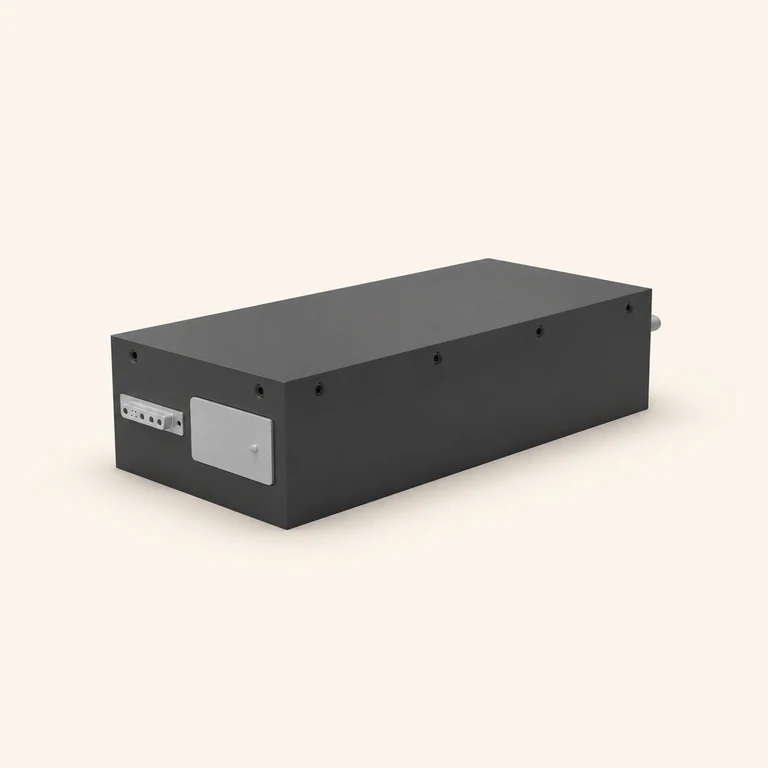
Read the product-family reference →AI illustration based on the first matched catalogue render; not stock, a delivered product or an exact configuration guarantee. The two entries were observed on 1 November 2026; original image files were retrieved on 11 November 2026. Current product-body access remains unavailable.
The supplier website documents industrial lithium batteries, 48V unmanned-forklift battery product. This Shenzhen record helps a buyer prepare a documented research route; it is not a statement of current stock, final compatibility, pricing or commercial availability.
Use the documented scope to decide whether the company belongs in a shortlist, then give each shortlisted supplier the same written requirement. For a truck, include the handling task, rated load, load centre, lift height, aisle width, ground conditions, hours per shift, battery preference, quantity and destination. For an automated vehicle or system, add the pallet condition, pickup and drop points, traffic, interfaces, safety process, commissioning expectations and acceptance criteria.
Compare the response at configuration level. A generic product category, a capacity headline or an automation label does not establish the exact model, included equipment, charger or battery scope, integration work, installation, lead time, warranty route, service coverage, stock or export handling. Ask the party issuing the quotation to state what it will supply and which assumptions remain open.
A supplier profile is most useful when it narrows a broad search into a small set of questions. Start by separating the job from the product name. For example, a buyer may need a pallet truck for horizontal movement, a reach truck for racking, a counterbalance truck for loading work, an explosion-proof configuration for a defined area, or an autonomous vehicle as part of a wider material-flow system. This record can help place the supplier website in the right research route, but it does not replace the supplier’s current technical and commercial response.
Before requesting information, write down the application in terms the supplier can assess: the load and its centre, lift height, aisle and turning space, floor condition, indoor or outdoor use, shift pattern, charging opportunity, attachments, quantities and destination. For an automation project, also describe the route, handover points, traffic, exception cases, WMS or ERP interfaces, safety constraints, acceptance tests and the local support expectation. A detailed brief reduces the chance of comparing unlike proposals.
When responses arrive, check whether every supplier is answering the same requirement. Ask for the proposed model or system architecture, the configuration basis, included hardware and software, product literature, drawings where relevant, delivery scope, lead time, commercial terms, warranty boundary and support process. Do not convert a website category into a compatibility, compliance or availability conclusion. Keep product selection, site safety and final contracting as separate confirmation steps.
Keep the final evidence pack with the enquiry. It should include the written requirement, supplier response, proposed configuration, referenced documents and the questions that remain unanswered. This provides a clear record for later technical review, commercial comparison and supplier follow-up.
This profile is based on a reachable company website and the product or company material visible there on the review date. Legal-entity and registration matching are reviewed separately. ForkliftIQ does not infer factory ownership, certification, current availability, pricing, compatibility, export coverage or project results from the website text. The supplier’s website is shown as plain text below, rather than as an outbound hyperlink.
Confirm the active legal or trading name, named contact, exact product or system proposal, product literature, included and excluded scope, price basis, lead time, delivery terms, documentation, spare-parts route and warranty support. If the request concerns a replacement part, confirm fitment against the truck model, serial information, existing label or part number and photographs.
Featured placement, product catalogues, verified business information and enquiry-routing options may be added to this profile in the future. Until then, the page remains a neutral, website-researched directory record.
Ask the supplier to connect the proposed equipment or component to a written operating requirement. The response should identify the exact model or part, technical assumptions, interfaces, included options, documentation, delivery scope, commissioning responsibility, warranty boundary and after-sales route. For a complete truck, require residual-capacity evidence for the proposed mast and attachment. For a replacement component, preserve the truck serial number, original label, dimensions, connectors and mounting details, then require the matching basis in writing before payment.
Share truck type or automation outcome, load, lift height, operating environment, quantity and destination. For parts, include truck identity and component evidence.