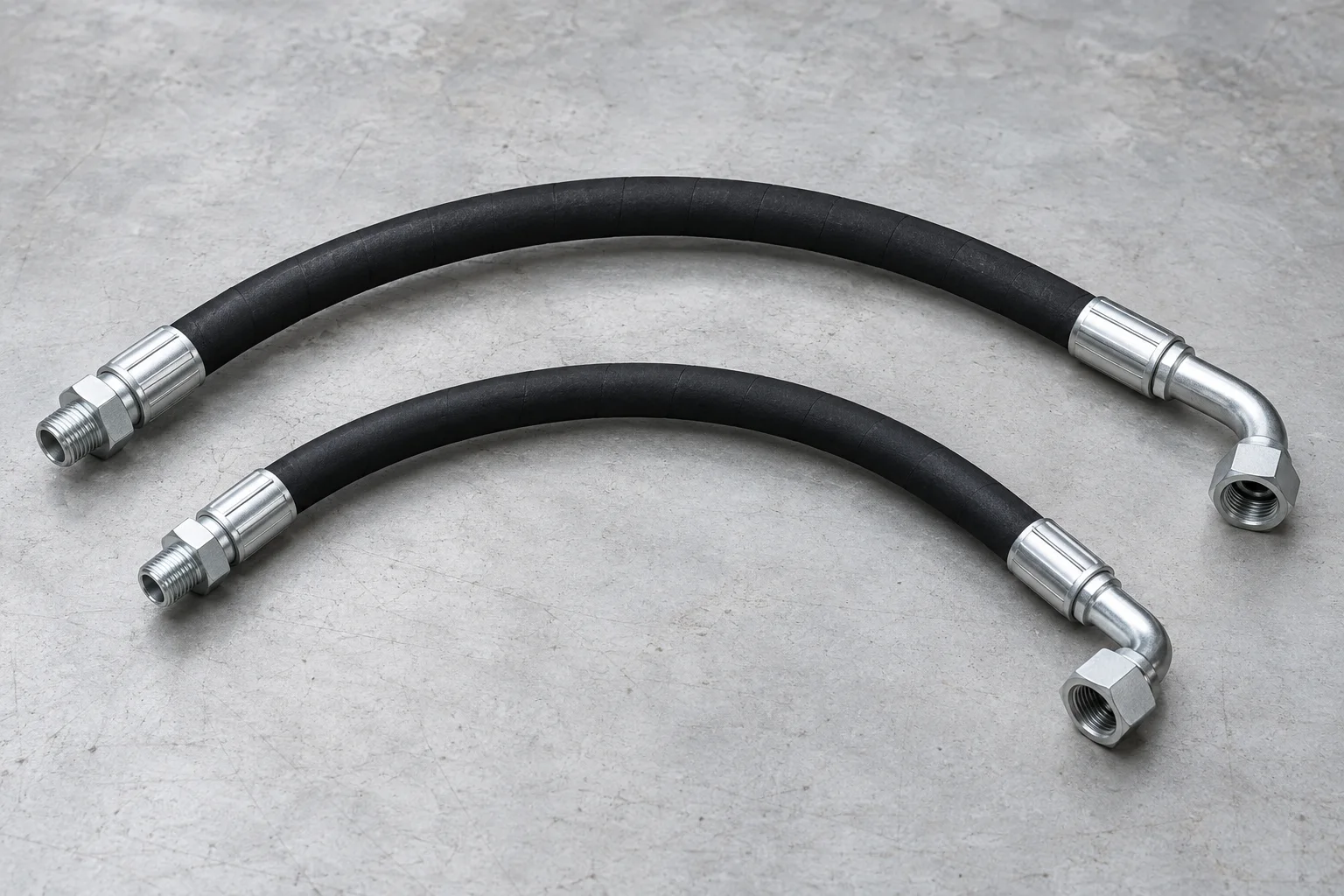
Order a documented hose assembly rather than a hose diameter alone. Preserve the assembly reference, end connections, orientation and routing record. The available supplier profiles below are related cylinder identification routes, not verified hose stockists.
A hose manufacturer marking and an assembled-hose identifier can serve different purposes. Parker’s PTS page explains an identification system for retrieving a registered hose assembly specification. That is an example of a traceable assembly route, not a system present on every forklift. Retain any original assembly tag, equipment part number and drawing reference before requesting a proposal. If no identifier exists, record the gap explicitly.
More guidance for this step
Keep both ends in the request
Include the documented connection at each end and any orientation information from the original assembly drawing. Do not identify a thread or sealing interface solely from a casual photograph. A familiar fitting size can leave the actual connection standard unresolved. Send safely accessible photographs and existing records, then ask the supplier to return a proposed assembly drawing with the connection details and differences clearly stated.
Describe length and routing from records
Preserve the original assembly length convention, end orientation and routing information where the manufacturer record provides them. State the connected pump, valve, cylinder or attachment identity. This enquiry should not require disconnection, movement of a loaded mast or manipulation of a pressurised line. Mark missing information unknown and obtain the applicable records through the responsible service route rather than inventing a measurement method.
More guidance for this step
Treat the hose and fittings as one proposal
Request the exact hose designation, fitting references and completed assembly specification. Keep the documented fluid, duty and environmental requirements with that proposal. An isolated hose pressure marking does not describe every aspect of an assembled replacement. This guide does not prescribe assembly tooling, crimp settings, bending limits, operating pressures or substitution tests. The supplier and responsible equipment parties must establish the applicable specification.
Make the supplier evidence gap visible
No independent hose inventory was established for the existing profiles connected here. Zhongtian’s forklift cylinder catalogue can help identify a related cylinder assembly; it is not evidence that the company sells the required hose. Use the profile only for that clearly stated identification enquiry, or continue in the parts supplier directory. Do not assume that a broad hydraulic category means a supplier can provide every hose assembly.
Compare a documented finished assembly
Ask whether the offer is a finished hose assembly, loose hose, fittings or an assembly service. Require the contents, proposed reference, supporting drawing, condition and applicable quality documentation to be specified. Keep quantity, destination, delivery terms and warranty separate from technical acceptance. A report of leakage or hose damage is not a diagnosis of the whole system; use the equipment-specific assessment to define the purchasing requirement.
Supplier profiles for this requirement
These company routes are tied to readable manufacturer or company-controlled material reviewed on 2 October 2026. Use the stated scope to begin a shortlist. A profile does not establish current stock, certification, authorisation or a match for your truck.
Its manufacturer catalogue separates lift, tilt, steering, attachment, AGV and reach cylinders. This is a cylinder identification route; it does not establish independent seal-kit or hose inventory.
For additional candidates, use the parts supplier directory. Ask each supplier to return the exact proposed item, condition, included documents, unresolved differences, quantity, destination and current delivery terms. Keep technical acceptance separate from commercial availability.
A direct specialist enquiry route
Hebei Sanye Fluid Technology — Hydraulic hoses, fittings and assembly enquiries. The official company and category bodies establish a component-focused enquiry route, separate from the assembly identification channels listed above.
Define hose, end fittings and complete assembly as separate quotation scopes. Preserve the existing assembly reference, documented connection designations and available drawing. Ask the supplier to explain the complete proposed item and its matching basis. Keep the length definition and end orientation tied to the same drawing; an image of similar hose or a broad hose-standard category is not a replacement approval.
The official body includes material-handling applications, but this is not evidence of truck-specific supply, current stock or OEM approval. No pressure or temperature figure is extrapolated from a generic category. Website production scale, quality-test and customer-testimonial claims are excluded from independent supplier evaluation. This profile contains no crimping, fitting substitution, routing or field-repair instructions.
No. Preserve the complete assembly and its end connections, orientation and applicable specification.
Does every forklift hose have a PTS ID?
No. It is a manufacturer tracking example, not a universal equipment feature.
Are the linked profiles verified hose suppliers?
No. The stated route is for related cylinder assembly identification.
Should I remove a hose to complete this enquiry?
This guide does not ask for removal or pressurised-system work. Use existing records and safely accessible photographs.
Primary-source notes · reviewed 2 October 2026
The references below support the stated category and identification examples. Manufacturer marketing statements are not treated as independent tests. No model-specific operating values, repair procedures or performance promises are inferred for another machine.
Related cylinder identification, not hose stock evidence: https://www.handelic.com/cn/products.php?tid=9
Prepare a parts matching request
Send the equipment identity, complete component reference, existing drawings or label photos, requested scope, quantity and destination. Mark missing information unknown and ask suppliers to answer the same written requirement.