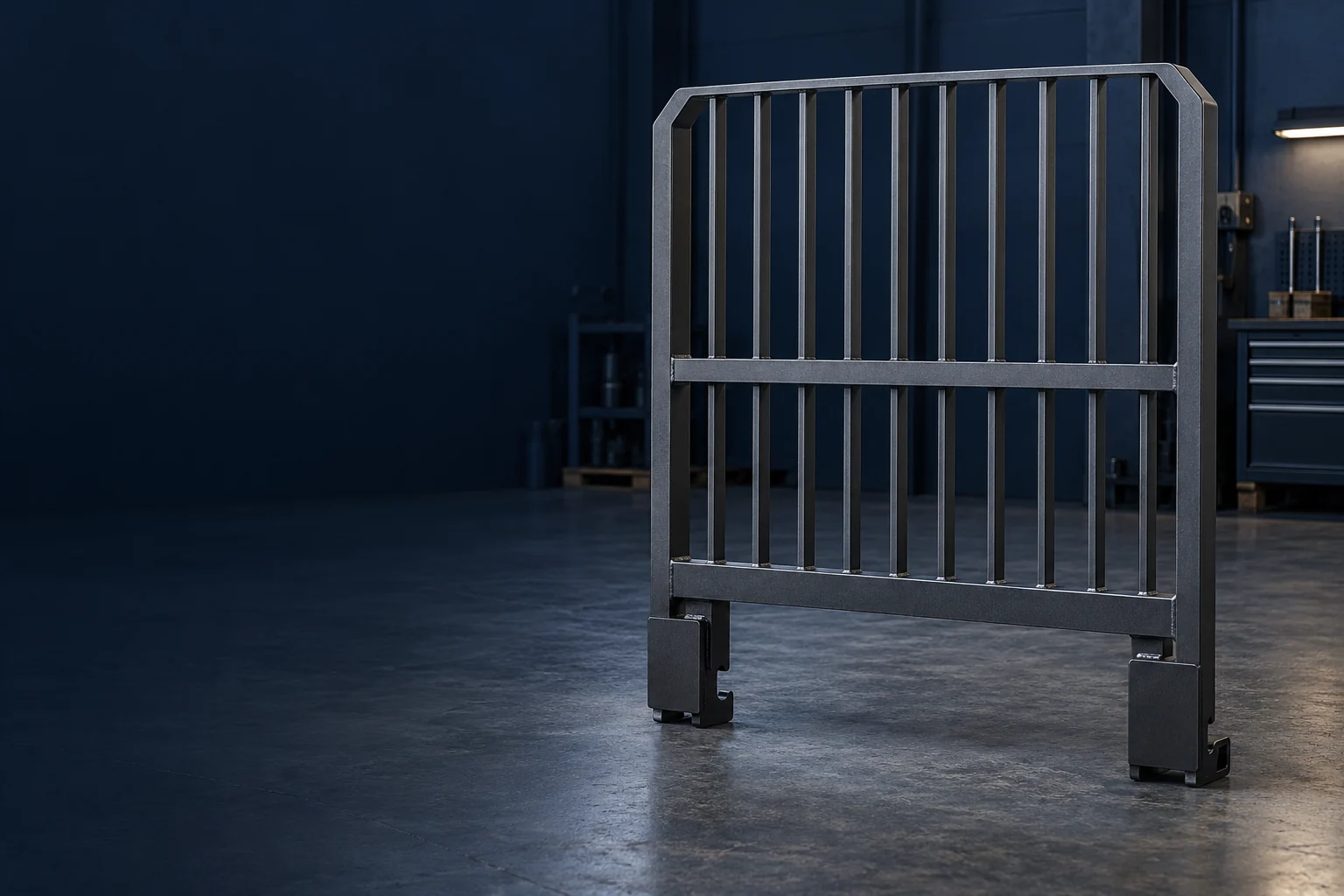
Identify a forklift load-backrest enquiry from the exact truck, carriage or attachment and the documented frame reference. Keep a backrest extension separate from an overhead guard, carriage and other load restraints. Request the offered mounting drawing and application-specific review; a similar mesh or bar appearance alone does not approve a replacement.
Use the assembly name and position in the equipment documentation. A load-backrest extension behind the load is a different item from a guard above the operator, a carriage frame or a clamping attachment. Do not turn similar protective-looking steelwork into an interchangeable category. State the component required and preserve its connection to the truck or attachment. The generic lattice illustration provides orientation only; it does not establish a particular restraint performance, field of protection or compliant installation.
More guidance for this step
Retain the actual frame and mounting reference
Copy the complete reference from existing frame, truck or attachment records and request the current offered drawing. Keep frame geometry and mounting information together rather than using height or width as a standalone selection rule. Cascade’s reviewed integral-attachment page mentions backrest mounting provisions, which supports a related document enquiry. It does not approve a generic bolt pattern on another assembly. Ask the proposed supplier to identify the relevant equipment drawing and any unresolved connection or supply-scope difference.
Make missing information visible
Begin with the truck manufacturer, full model, serial number and the name or position used in its parts documentation. Retain the assembly reference when the component belongs to a mast, carriage, axle or wheel. An incomplete reference should remain incomplete in the enquiry: do not silently add a familiar suffix or convert an unclear photograph into a catalogue designation. Existing records and safely available label photographs can help a supplier ask the right follow-up question. This page does not require dismantling or operating equipment to obtain information.
State the handling application without promising protection
Record the documented load-handling requirement and ask which equipment-specific documents address the proposed frame. Bar and mesh appearance can help describe an enquiry, but appearance alone does not establish performance or retention of a particular load. Keep packaging and load-restraint questions separate from the identity of the backrest. This page supplies no strength calculation, numerical protection rating or general legal requirement. Any applicable jurisdiction, workplace and equipment requirements need their own current assessment for the actual application.
More guidance for this step
Clarify frame-only and attachment-option quotations
Ask whether the offer is a standalone frame, an attachment option or a complete supplied assembly. Identify included mounting components and obtain the supporting drawing for the exact proposed item. A catalogue reference to backrest provisions does not prove a loose replacement frame is available. Keep any existing professional condition assessment separate from procurement. This guide does not instruct welding, drilling, modifying a frame or removing equipment protection; it supports a documented enquiry and an explicit list of unresolved requirements.
Keep the quotation technically comparable
Ask every candidate to quote the same written requirement. Separate the original equipment reference, the supplier catalogue reference and the reference actually offered. Ask for the offered manufacturer, condition, supplied quantity, included components and documents. A substitution proposal should list unresolved differences rather than hide them behind the word compatible. Compare the commercial offers only after those differences are visible. A lower price or shorter delivery time does not establish technical acceptance, and a directory entry is not an inventory reservation.
Separate source evidence from supplier promises
The source notes below document the category information actually reviewed. A company catalogue can establish that a business presents a relevant product family, but that does not prove that a pictured item is currently available or that a proposed component fits another manufacturer’s machine. Request written confirmation for the exact offered item. Keep any claimed original status, certification or authorised relationship distinct from the item description and ask for its basis. This guide adopts no marketing durability figures, market-share claims or unnamed customer approvals.
Close the enquiry with explicit responsibilities
Record who will resolve the remaining technical questions and which documents will support that decision. State quantity, destination, required delivery information and the scope of any separately quoted service. Keep a professional condition assessment distinct from the purchase request. This is an identification and procurement guide, not a removal, adjustment, repair or return-to-service procedure. If the supporting reference cannot be obtained, preserve the question as unresolved instead of buying on a symptom, a generic category picture or an assumed cross-reference.
Supplier profiles for this requirement
These company routes are tied to readable manufacturer or company-controlled material reviewed on 3 October 2026. Use the stated scope to begin a shortlist. A profile does not establish current stock, certification, authorisation or a match for your truck.
The reviewed integral-sideshifter page mentions load-backrest mounting provisions. Use this as a related attachment-document enquiry route. It does not establish a standalone backrest offer, a universal bolt pattern or current stock. Ask the responsible company for the exact required frame, drawing and supply scope.
For additional candidates, use the parts supplier directory. Ask each supplier to return the exact proposed item, condition, included documents, unresolved differences, quantity, destination and current delivery terms. Keep technical acceptance separate from commercial availability.
Purchasing questions
Is a load backrest the same as an overhead guard?
No. Keep the assembly identity, position and documentation separate. A protective-looking frame is not evidence of equivalent purpose or performance.
Can I select a backrest by height and width alone?
No. Retain the exact equipment and frame references and request the offered mounting drawing and equipment-specific selection basis.
Does the Cascade route confirm standalone backrest stock?
No. It is a related attachment-document route based on published mounting provisions, not a verified stock offer or universal replacement.
Does this page establish whether a backrest is legally required?
No. It offers no jurisdiction-wide legal ruling. Resolve the current equipment, load-handling and workplace requirements for the actual application through the responsible qualified review.
Primary-source notes · reviewed 3 October 2026
The references below support the stated category and identification examples. Manufacturer marketing statements are not treated as independent tests. No model-specific operating values, repair procedures or performance promises are inferred for another machine.
Attachment-specific backrest mounting mention; related document route only: https://www.cascorp.com.cn/home.php/en/Product/p_info/id/2/sid/14/info_id/150
Prepare a parts matching request
Send the equipment identity, complete component reference, existing drawings or label photos, requested scope, quantity and destination. Mark missing information unknown and ask suppliers to answer the same written requirement.