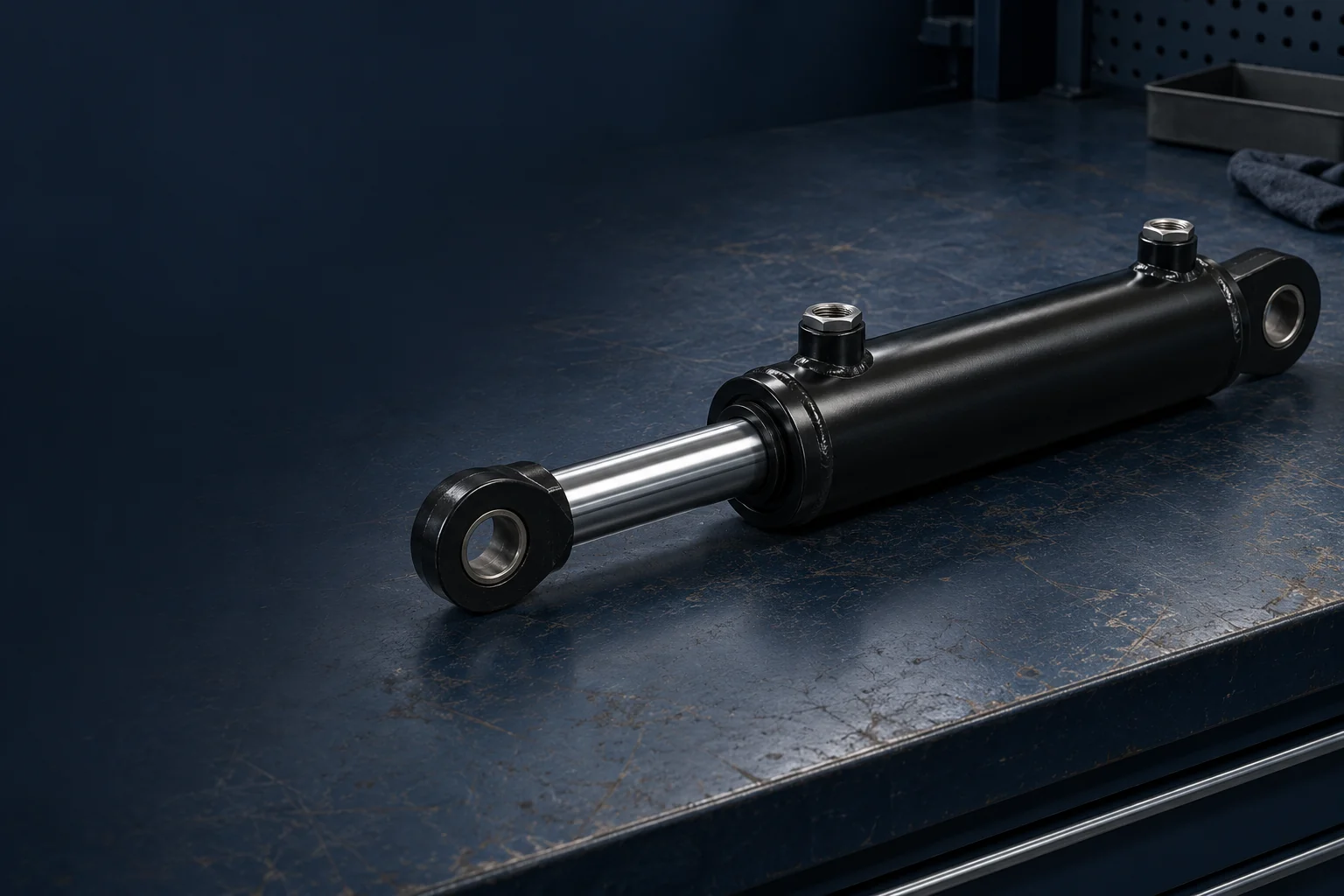
Identify a mast tilt-cylinder request from the truck, mast assembly and complete cylinder reference. Keep tilt actuators separate from lift and steering cylinders. Preserve recorded side, mounting and drawing information; do not infer a diagnosis, seal-kit suitability or an automatic paired replacement from mast movement or a generic illustration.
Begin with the truck model and serial number, mast identity and the existing tilt-cylinder reference. The catalogue term tilt cylinder describes a component function; it does not tell you how every mast is arranged or how many units your machine uses. Preserve any recorded left or right designation and the relevant drawing position. If a previous repair changed the assembly, retain that record as an additional question rather than assuming the original catalogue alone describes the current configuration.
More guidance for this step
Request drawing fields rather than guessed dimensions
Ask for the documented cylinder drawing and the proposed replacement drawing. Keep the recorded bore, rod, stroke, mounting centres, pin interfaces and port information in their original units and conditions. Extended and retracted values must be identified separately where the documents provide them. Do not use a matching outside appearance to fill gaps. This page requests records and supplier explanations; it does not direct cylinder removal, mast movement or measurement under load to collect those fields.
Separate the cylinder, kit and paired scope
Specify whether the enquiry is for one complete cylinder, a documented set, a seal kit or another subcomponent. Ask what the supplied item includes and which hardware or documents remain separate. A kit description must identify its parent cylinder and declared contents. Neither a leak nor a smooth-looking rod establishes that resealing is appropriate. Pair quantity and side designations should follow the documented requirement, rather than a universal instruction to replace both sides together.
More guidance for this step
Use catalogue evidence for the claim it supports
Zhongtian publishes a named tilt-cylinder entry within its forklift and logistics-cylinder catalogue. That is sufficient to identify a category discovery route, but the readable entry does not provide a dimensioned replacement drawing for your truck. Request the offered item reference and application basis. Keep the illustrative image separate from that proposal. Do not infer available stock, seal kits, export terms, original-brand status or machine fit from the presence of a product category.
Compare a complete written proposal
Send the same equipment record and requested scope to each candidate. Require the response to identify the offered reference, current drawing revision, condition, included items and unresolved differences. Keep any proposed change from the existing drawing visible. Ask who is responsible for application review and what documentation they need. Commercial comparisons should then cover quantity, destination, availability and delivery terms; a low price cannot resolve a missing mounting, side or assembly identification field.
Keep mast symptoms out of replacement rules
Record existing service findings if available, but do not interpret mast drift or uneven motion as proof of a worn piston seal. This purchasing guide provides no pressure test, disassembly, resealing decision or machine release instruction. A qualified service process must address the actual equipment condition under applicable documentation. The useful output here is a bounded enquiry with known references, unknown drawing fields and requested supplied scope, so a supplier cannot silently substitute a generic cylinder.
Supplier profiles for this requirement
These company routes are tied to readable manufacturer or company-controlled material reviewed on 3 October 2026. Use the stated scope to begin a shortlist. A profile does not establish current stock, certification, authorisation or a match for your truck.
The company-controlled forklift and logistics-cylinder catalogue contains a named tilt-cylinder entry. This supports a category discovery route. No dimensioned replacement, seal kit, matched pair, stock or machine-specific fit is established by that entry. Request the complete offered reference and current equipment-specific drawing.
For additional candidates, use the parts supplier directory. Ask each supplier to return the exact proposed item, condition, included documents, unresolved differences, quantity, destination and current delivery terms. Keep technical acceptance separate from commercial availability.
Purchasing questions
Does mast drift prove the tilt cylinder needs seals?
No. A symptom does not establish the failed component or justify a repair. Keep professional service findings separate from the procurement request.
Must tilt cylinders always be ordered as a pair?
This page gives no universal pairing rule. Use the documented assembly requirement and identify side, quantity and supplied scope explicitly.
Can bore and rod size alone confirm the replacement?
No. Preserve the complete reference, application and current drawing, including documented mounting and connection details.
Does the Zhongtian entry confirm a seal kit?
No. It establishes a tilt-cylinder category route only. Any kit or complete replacement proposal requires separate identification and documentation.
Primary-source notes · reviewed 3 October 2026
The references below support the stated category and identification examples. Manufacturer marketing statements are not treated as independent tests. No model-specific operating values, repair procedures or performance promises are inferred for another machine.
Named tilt-cylinder entry; no dimensioned replacement specification: https://www.handelic.com/cn/productsd.php?pid=21&tid=9
Prepare a parts matching request
Send the equipment identity, complete component reference, existing drawings or label photos, requested scope, quantity and destination. Mark missing information unknown and ask suppliers to answer the same written requirement.