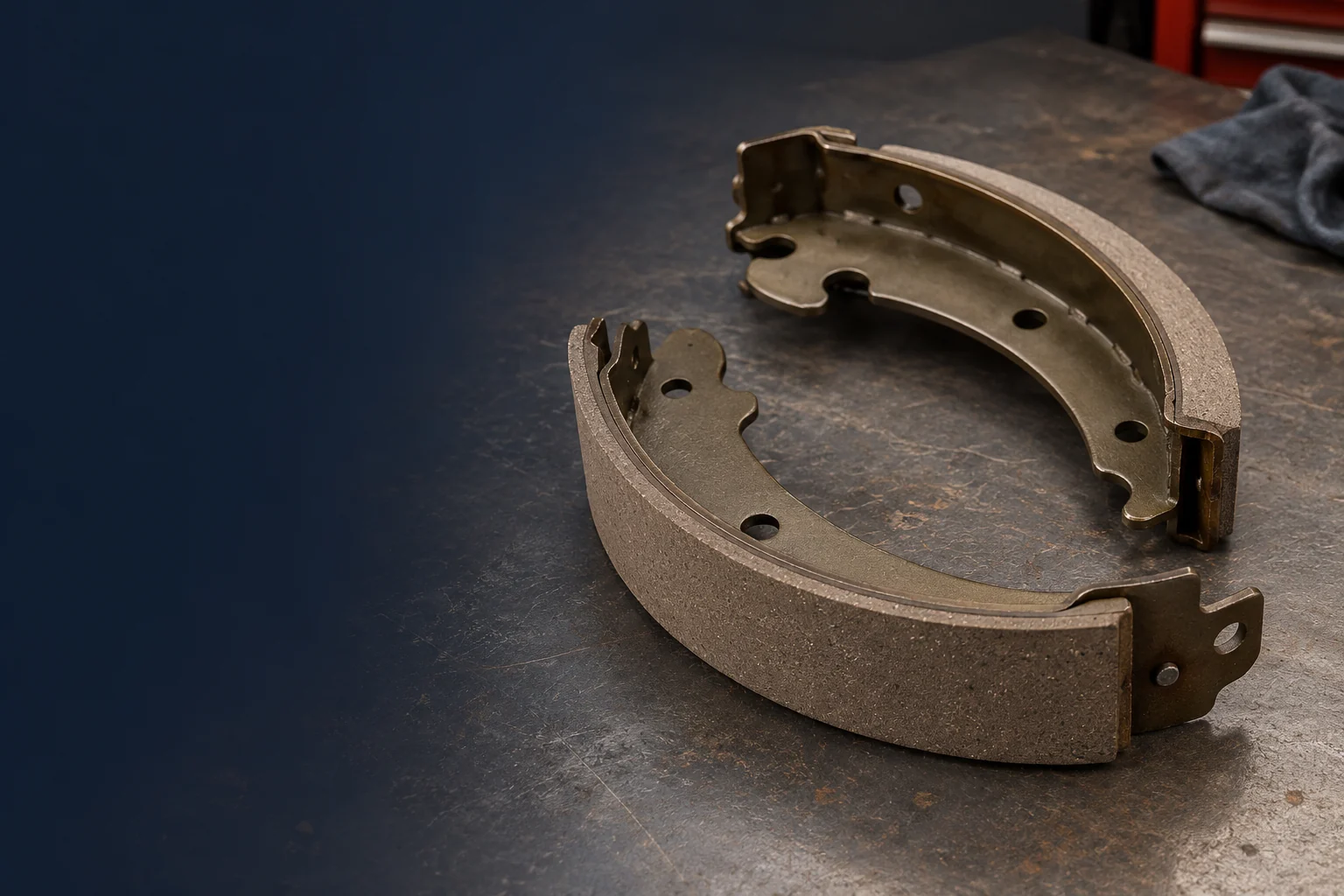
Identify forklift brake shoes against the documented brake assembly and complete part reference. Distinguish drum shoes, lining-only supply, disc pads and parking-brake components. A nominal drum size, truck brand or visual resemblance is insufficient to approve a safety-critical replacement.
Record the truck make, model, serial identity and documented brake assembly before searching for a shoe. Ask whether the requirement is for the service brake, a separate parking-brake arrangement or another component. Keep drum-shoe enquiries distinct from disc pads and other brake technologies. This page does not claim that a particular brake design is present on most trucks. Obtain the parts illustration or service reference for the actual machine so a broad model family is not mistaken for the required assembly identification.
More guidance for this step
Retain the shoe reference and dimensional drawing
Keep the complete shoe number and assembly drawing item number, including suffix and revision where available. Request a dimensional drawing that covers the relevant shoe and lining geometry, locating features, end interfaces and supplied attachment details. Photographs communicate shape, but diameter and width alone cannot establish a match. Do not use an estimated dimension or worn lining as the design specification. Have the supplier identify the document supporting its proposed item and state every unresolved difference for review against the applicable brake documentation.
Separate a complete lined shoe from lining material
State whether the request concerns complete shoes with lining, bare carriers, lining-only material or an identified hardware kit. Ask for the specified lining material and attachment details, included quantities, drawing basis and documents supporting the proposed configuration. This is a purchasing distinction, not an instruction to reline or modify a brake component. Bonded and riveted product descriptions do not establish interchangeable designs or acceptable service methods. Keep material, geometry and approved assembly relationships visible rather than comparing only photographs and a headline price.
More guidance for this step
Catalogue labels support discovery, not fit approval
The reviewed Zhaohui company website presents forklift brake shoes and separate brand-labelled examples, including HELI and Linde descriptions. This supports a supplier discovery route. Its marketing statements about direct installation, braking performance, materials or brand compatibility are not independently verified here and are not adopted as guarantees. Ask the supplier to identify the exact proposed drawing, reference and supported application. A capacity or brand in a product title must not be extended to every truck with that badge or nominal capacity.
Define the supplied set and acceptance documents
Request the manufacturer-specified replacement scope and the quoted quantity, rather than assuming that one item means one wheel or an entire axle set. Ask which hardware, springs or accessories are included and which must be addressed separately under the applicable documentation. Retain condition, traceability, batch identification where supplied, quality documents and warranty terms with the proposal. This page does not prescribe a universal set-replacement procedure. The responsible technical reviewer must reconcile the proposed supply with the actual brake assembly and its safety requirements.
Keep symptoms out of the compatibility decision
A noise, altered pedal feel, pulling or reduced braking describes a safety concern, not proof that a particular shoe is the correct purchase. Record existing inspection findings and the identified requirement without proposing adjustment or repair steps from a generic page. Safe equipment handling, diagnosis and return to service belong to the responsible competent personnel and applicable manufacturer instructions. ForkliftIQ does not promise a match before dispatch or claim current stock. Preserve unanswered technical questions and the supplier’s written responses before making a purchasing decision.
Supplier profiles for this requirement
These company routes are tied to readable manufacturer or company-controlled material reviewed on 3 October 2026. Use the stated scope to begin a shortlist. A profile does not establish current stock, certification, authorisation or a match for your truck.
The company website presents forklift brake-shoe families and several brand-labelled examples. Ask for the exact drawing, friction specification and supplied set. Website fit and performance statements have not been independently verified.
For additional candidates, use the parts supplier directory. Ask each supplier to return the exact proposed item, condition, included documents, unresolved differences, quantity, destination and current delivery terms. Keep technical acceptance separate from commercial availability.
Purchasing questions
Can diameter and lining width confirm a match?
No. Retain the complete reference, assembly identity and dimensional documentation. Limited dimensions are enquiry inputs, not final compatibility evidence.
Are disc pads and drum shoes the same part family?
No. Identify the actual brake design and application, then use the corresponding parts breakdown rather than substituting a similar product name.
Does a HELI or Linde catalogue label establish fit?
No. Brand-labelled examples support discovery. Ask for the exact reference, drawing, configuration boundary and supplier matching basis.
Does this page tell me how many shoes to replace?
No. Define the proposed supply quantity against the manufacturer-specified scope and competent technical review; a generic page cannot approve the replacement procedure.
Primary-source notes · reviewed 3 October 2026
The references below support the stated category and identification examples. Manufacturer marketing statements are not treated as independent tests. No model-specific operating values, repair procedures or performance promises are inferred for another machine.
Send the equipment identity, complete component reference, existing drawings or label photos, requested scope, quantity and destination. Mark missing information unknown and ask suppliers to answer the same written requirement.