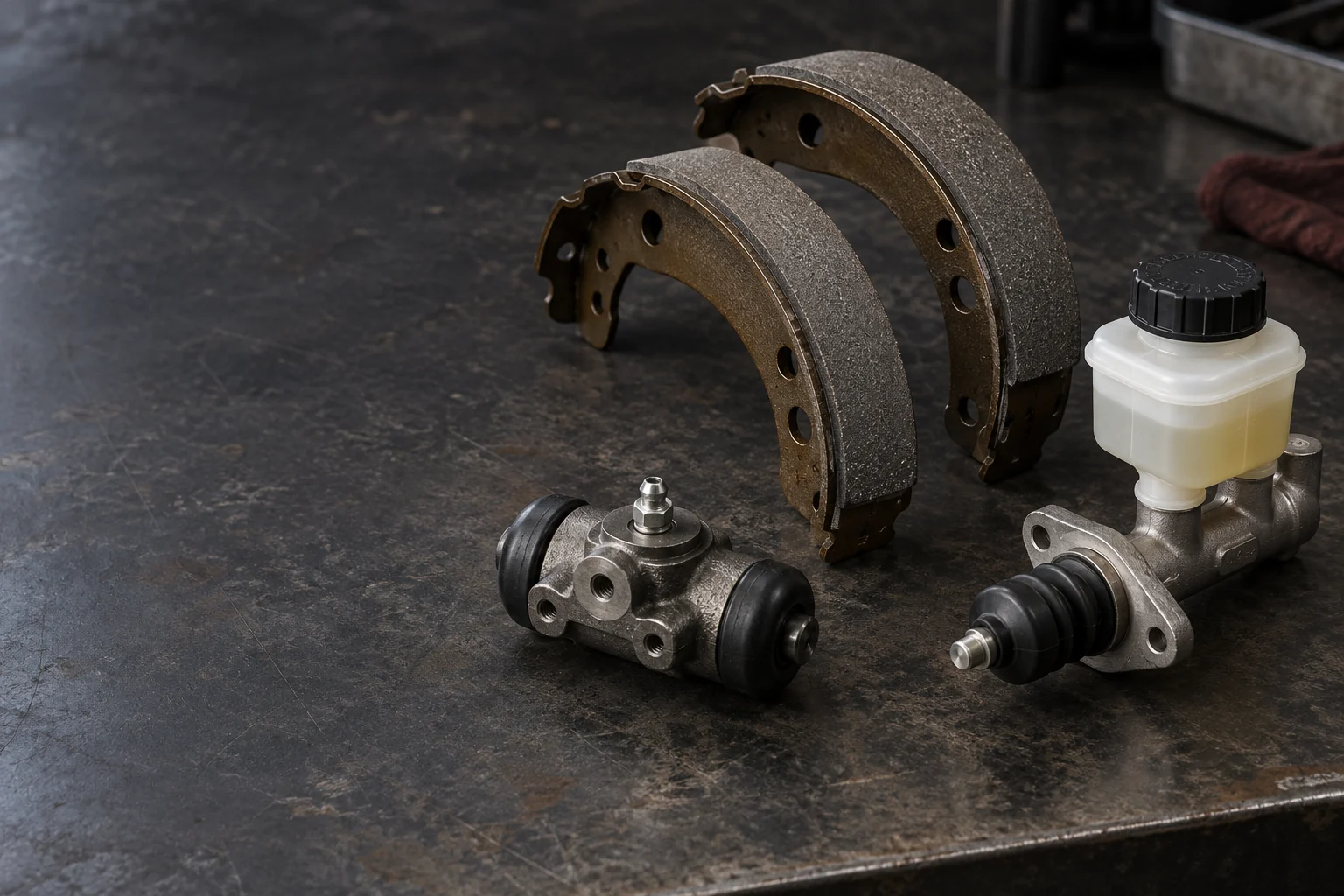
Prepare a forklift brake-parts enquiry from the documented component and equipment identity. Separate service-brake, parking-brake and actuation requests; then distinguish the component, kit and complete assembly. A general braking symptom does not establish which item to buy. Use the narrower category guides and obtain a documented proposal for the exact truck.
Choose the component job before requesting a price
Begin by identifying which brake component the purchase request concerns. A purchase enquiry does not diagnose the truck. Record the manufacturer, complete model and serial number together with the existing brake or axle assembly reference. Identify whether the requested item belongs to the service brake, parking brake or actuation arrangement from the actual documentation. Do not infer a brake design from capacity, fuel type or a broad brand name. If the needed component has not been established, describe that uncertainty before asking a supplier to quote.
More guidance for this step
Separate related categories and complete assemblies
Drum shoes, hydraulic cylinders, calipers, actuators and parking mechanisms are related to braking but are not one generic replacement category. Likewise, a wheel cylinder and a master cylinder have distinct positions and component references. Use the shoe and master-cylinder pages for their narrower enquiries, and retain an axle or brake assembly record where it supplies the component identity. For a complete assembly, request an itemised inclusion list; the phrase complete brake does not tell a buyer whether every associated actuator, bracket, cable or accessory is supplied.
Use a catalogue as discovery evidence
Zhaohui publishes forklift drum-brake shoe and parking-brake shoe examples on its company-controlled website. That supports a bounded shoe-category supplier route. It does not establish a master-cylinder, disc-caliper or full braking-system offer. HELI separately publishes a component brake category and technical support; its profile can assist a HELI equipment-reference enquiry. Neither source permits ForkliftIQ to promise inventory, all-brand coverage or tested braking performance. Ask each company to define exactly which component and current document answer the request, rather than treating a directory listing as approval.
More guidance for this step
Keep the written identification record consistent
Give every supplier the same component name, full reference, suffix or revision, equipment identity, quantity and destination. Include existing labels, drawings and service records where available. Photographs can support identification but do not establish material characteristics or an approved substitute. If a supplier proposes an alternative number, require its source and the differences in the written response. Treat dimensions and mounting details as identification inputs rather than proof of braking performance. Do not combine an unsupported photograph-based match with an assumption that the part has original-brand provenance.
Separate symptoms, purchasing and operating safety
When the required component is unresolved, obtain a qualified assessment using the applicable truck documentation before choosing repair parts. This purchasing guide does not explain how to test, adjust, bleed, wire, dismantle or install a brake assembly, nor does it provide a return-to-service decision. A catalogue image, an inexpensive quotation or a newly purchased part cannot establish that the truck is safe to operate. The purchasing record should identify what remains uncertain and which equipment-specific documents a competent reviewer will need, without supplying workshop prescriptions.
Compare offers by scope and supporting documents
A useful response identifies the quoting legal entity, offered manufacturer and reference, condition, supplied contents, quantity, technical basis, unresolved differences and current commercial terms. Ask whether a kit is limited to listed components or includes associated hardware. Confirm availability, lead time, destination requirements and warranty terms for that specific proposal. Keep commercial acceptance separate from equipment application and safety assessment. Use the narrower component pages before submitting a parts-matching request so that suppliers receive a defined requirement instead of a broad request to repair an unspecified braking problem.
Supplier profiles for this requirement
These company routes are tied to readable manufacturer or company-controlled material reviewed on 3 October 2026. Use the stated scope to begin a shortlist. A profile does not establish current stock, certification, authorisation or a match for your truck.
The company-controlled catalogue explicitly presents forklift drum-brake shoes and parking-brake shoe examples. Use this route for a documented shoe enquiry; it does not establish a master-cylinder, disc-caliper or complete braking-system offer. No catalogue marketing performance, direct-fit, origin or inventory claim is adopted.
The manufacturer-controlled component site publishes component categories and technical support. For a HELI truck, this is an equipment and component-document identification route. It is not a confirmed master-cylinder or hydrostatic steering-unit offer, a Danfoss dealer listing, or a route that covers another truck brand. Obtain the exact responsible entity and component proposal separately.
For additional candidates, use the parts supplier directory. Ask each supplier to return the exact proposed item, condition, included documents, unresolved differences, quantity, destination and current delivery terms. Keep technical acceptance separate from commercial availability.
Purchasing questions
What information starts a brake-parts enquiry?
Start with the complete truck identity, existing brake or axle assembly reference, exact component name and full number. Add the requested scope, quantity and destination.
Does a shoe supplier also supply every brake component?
Do not assume so. The listed shoe route is supported only for its published category. Ask for a separate, documented offer for cylinders, calipers or complete assemblies.
Can a photograph approve a brake replacement?
No. A photo is an identification aid, not approval of the equipment application or braking performance. Obtain the documented basis for the proposed component.
Does this page provide testing or return-to-service instructions?
No. It organises parts research and purchasing records. Brake inspection, repair and operating-safety decisions require qualified assessment using the applicable equipment documentation.
Primary-source notes · reviewed 3 October 2026
The references below support the stated category and identification examples. Manufacturer marketing statements are not treated as independent tests. No model-specific operating values, repair procedures or performance promises are inferred for another machine.
Manufacturer brake component category; not a listing for every component: https://lbj.helichina.com/info.php?class_id=102110
Manufacturer component support and enquiry scope: https://lbj.helichina.com/
Prepare a parts matching request
Send the equipment identity, complete component reference, existing drawings or label photos, requested scope, quantity and destination. Mark missing information unknown and ask suppliers to answer the same written requirement.