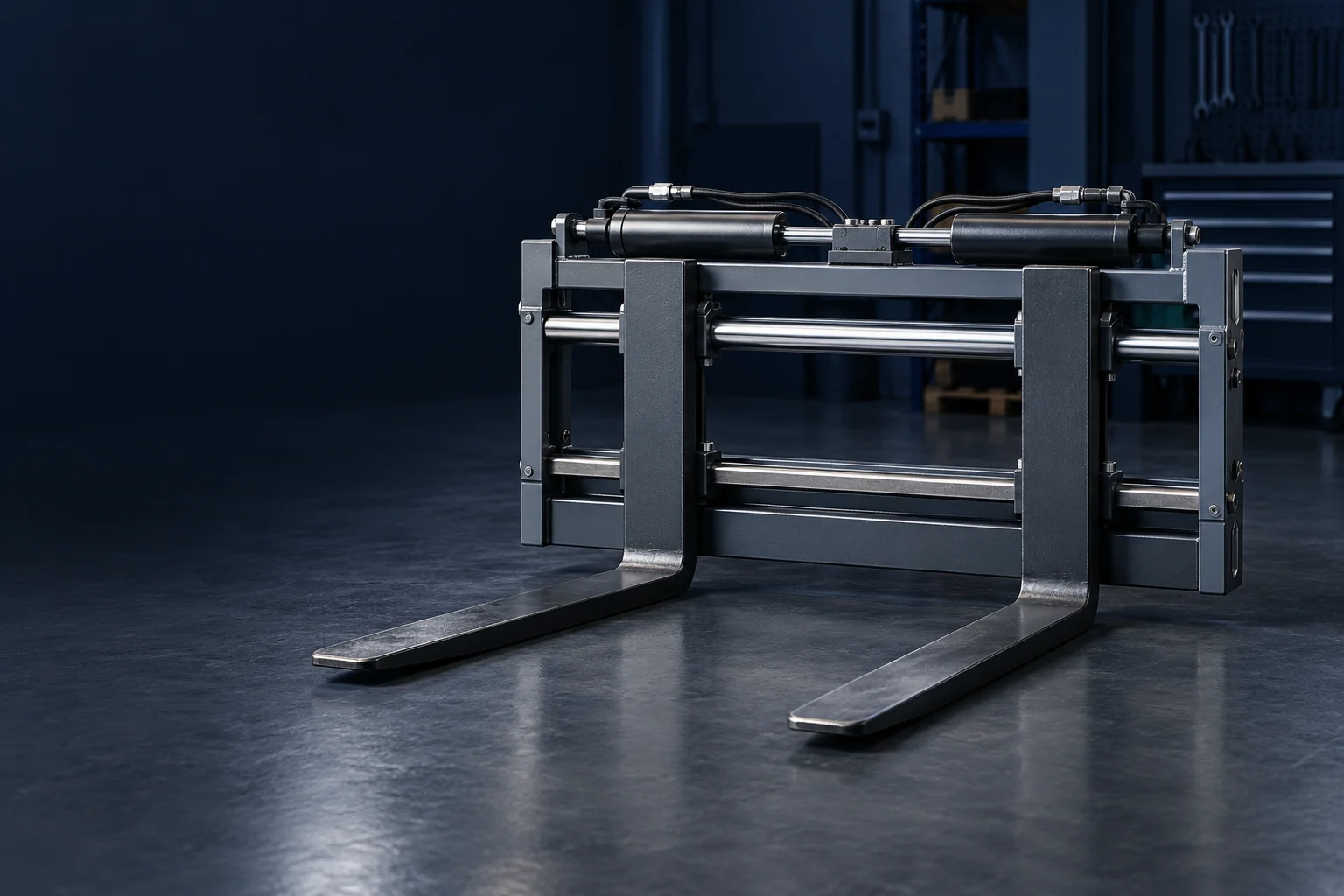
Prepare a fork-positioner enquiry from the complete attachment reference, equipment identity and documented functions. Keep fork-spacing adjustment, sideshift and clamping requirements separate. Request the offered mounting, fork and control documentation; a generic family name, maximum opening description or truck tonnage alone does not establish a replacement.
Longhe’s catalogue separates sideshifting fork-positioner families from an individual fork-adjusting family. This is a useful category distinction, not a universal control diagram. Ask which functions the offered item actually provides and record them separately in the enquiry. Fork spacing, lateral sideshift and clamping are different requirements; do not use one term as approval for another. A combined attachment needs its own complete reference, and a picture of movable fork carriers does not identify independent controls or an operating mode.
More guidance for this step
Keep the required fork arrangement explicit
Clarify whether the request includes fork blades, movable carriers, a complete attachment or subcomponents only. Retain existing fork mounting and carriage information and ask for the offered drawing. If the requirement includes an opening range or fork length, use documented application information and ask the supplier how its proposal addresses it. Do not translate a pallet width into an assumed model or select from the largest opening figure alone. A catalogue family may contain configurations that require different enquiry records.
Make missing information visible
Begin with the truck manufacturer, full model, serial number and the name or position used in its parts documentation. Retain the assembly reference when the component belongs to a mast, carriage, axle or wheel. An incomplete reference should remain incomplete in the enquiry: do not silently add a familiar suffix or convert an unclear photograph into a catalogue designation. Existing records and safely available label photographs can help a supplier ask the right follow-up question. This page does not require dismantling or operating equipment to obtain information.
Request equipment and attachment documents together
Keep the truck model, serial identity, existing carriage and attachment reference in the same purchasing record. Ask for the documentation supporting the proposed functions, mounting and control interfaces. Include any existing application requirement without copying generic operating settings from another machine. An enquiry for a seal, cylinder or control component still needs the exact attachment drawing and component reference. This guide provides no hose connection sequence, pressure setting, adjustment method or trial-operation procedure for checking a proposed substitution.
More guidance for this step
Compare complete proposals without assuming interchange
Ask suppliers to identify the offered assembly, included forks and hardware, condition, documents and unresolved differences. Separate equipment-specific acceptance from the catalogue family’s marketing claims. The Longhe source supports a category route, not guaranteed universal integration, low maintenance or a measured productivity gain. A proposal for a combined sideshifting positioner should not be treated as identical to one for spacing adjustment only. Ask who will confirm the required truck and attachment documentation before proceeding beyond a shortlist.
Keep the quotation technically comparable
Ask every candidate to quote the same written requirement. Separate the original equipment reference, the supplier catalogue reference and the reference actually offered. Ask for the offered manufacturer, condition, supplied quantity, included components and documents. A substitution proposal should list unresolved differences rather than hide them behind the word compatible. Compare the commercial offers only after those differences are visible. A lower price or shorter delivery time does not establish technical acceptance, and a directory entry is not an inventory reservation.
Separate source evidence from supplier promises
The source notes below document the category information actually reviewed. A company catalogue can establish that a business presents a relevant product family, but that does not prove that a pictured item is currently available or that a proposed component fits another manufacturer’s machine. Request written confirmation for the exact offered item. Keep any claimed original status, certification or authorised relationship distinct from the item description and ask for its basis. This guide adopts no marketing durability figures, market-share claims or unnamed customer approvals.
Close the enquiry with explicit responsibilities
Record who will resolve the remaining technical questions and which documents will support that decision. State quantity, destination, required delivery information and the scope of any separately quoted service. Keep a professional condition assessment distinct from the purchase request. This is an identification and procurement guide, not a removal, adjustment, repair or return-to-service procedure. If the supporting reference cannot be obtained, preserve the question as unresolved instead of buying on a symptom, a generic category picture or an assumed cross-reference.
Supplier profiles for this requirement
These company routes are tied to readable manufacturer or company-controlled material reviewed on 3 October 2026. Use the stated scope to begin a shortlist. A profile does not establish current stock, certification, authorisation or a match for your truck.
The company catalogue distinguishes sideshifting fork-positioner families from an individual fork-adjusting family. This supports category discovery, not approval of a particular control arrangement, truck fit or stock item. Request the full offered reference and documentation for its functions, fork mounting and included scope.
For additional candidates, use the parts supplier directory. Ask each supplier to return the exact proposed item, condition, included documents, unresolved differences, quantity, destination and current delivery terms. Keep technical acceptance separate from commercial availability.
Compare the documented positioning functions
Longhe’s catalogue separates sideshifting positioner families from an individual-fork-adjusting family. Liandong’s current positioning category also distinguishes fork-positioner entries and integral combined sideshift-and-positioning entries. Ask which exact functions belong to the proposed assembly. A positioning family does not establish load clamping, automatic matching, common cylinders or a capacity-approved truck combination. Identify the forks, carriers, mounting items and documents included in the written offer.
Do not infer that function. Record the exact documented attachment functions and keep clamping requirements separate from spacing adjustment.
Do all fork positioners include sideshift?
No universal combination is assumed. The reviewed catalogue distinguishes categories; request the exact offered reference and function documentation.
Are forks always included with the attachment?
Do not assume so. Ask the offer to identify the included forks, carriers, mounting components and supporting drawings.
Can pallet width alone identify a suitable positioner?
No. Preserve the equipment and application requirements and request the proposed assembly’s documented selection basis, including unresolved interfaces and scope.
Primary-source notes · reviewed 3 October 2026
The references below support the stated category and identification examples. Manufacturer marketing statements are not treated as independent tests. No model-specific operating values, repair procedures or performance promises are inferred for another machine.
Company category entries distinguishing sideshifting and individual fork-adjusting families: https://www.longheglobal.com/fork-positioner/
Prepare a parts matching request
Send the equipment identity, complete component reference, existing drawings or label photos, requested scope, quantity and destination. Mark missing information unknown and ask suppliers to answer the same written requirement.