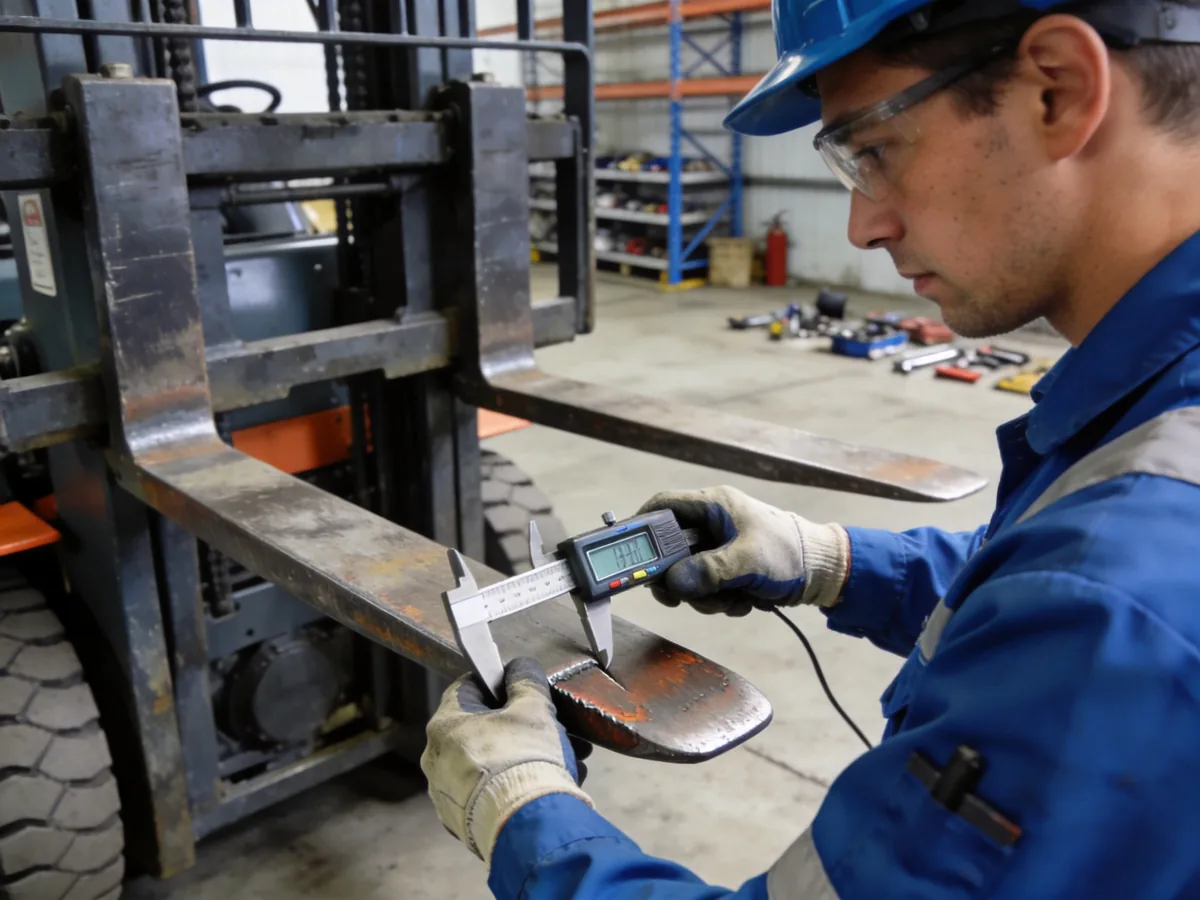
Worn or bent forklift forks are a serious safety risk. Check heel thickness, blade-to-shank angle, surface cracks and the locating latch; forks worn about 10 percent must be replaced, not repaired.
— Reviewed by the ForkliftIQ technical team
Forklift forks wear most at the heel, where they thin under load. Bent blades, a wrong blade-to-shank angle, surface cracks and a worn heel all reduce capacity and risk a dropped load. Inspect with calipers and an angle check, and remember worn forks are replaced, not welded.
Watch a fork wear-gauge inspection
This short field demonstration makes the two measurements easier to understand: first set the gauge against a known unworn reference area, then compare the fork heel and check the blade-to-shank angle. It complements the written crack, latch and matched-pair checks below.
Around 00:28: the gauge is set against a known unworn reference thickness on the upright portion of the fork.
Around 00:56: the gauge is moved to the heel area, about one inch from the bend, to compare remaining thickness.
Around 01:10: the gauge’s four contact points are used to check the blade-to-shank angle.
Use boundary: The video demonstrates the gauge method, not a universal pass/fail specification. Use the gauge instructions and the forklift or fork manufacturer’s limits. Remove cracked, bent or over-worn forks from service; do not weld or heat-straighten them.
Most likely causes
Figure 1: Diagnosing forks worn or bent — steps from this page (indicative).
Figure summary: Follow the diagnostic steps in order, working from the cheapest, most likely cause first and confirming with a test before replacing parts.
Heel wear — The fork heel thins under repeated load; about 10 percent thickness loss roughly halves the fork's safe capacity.
Bent blade or shank — Overloading or striking racking bends the blade or shank, throwing off the angle and load contact.
Surface cracks — Cracks at the heel or weld points can grow and cause sudden failure.
Worn or damaged locating latch — A worn positioning latch lets a fork slide or pop off the carriage.
How to diagnose it
1
Measure heel thickness with calipers and compare to the shank — about 10 percent loss means replacement.
2
Check the blade-to-shank angle, which should be about 90 degrees; more than about 3 degrees off means the fork is bent.
3
Inspect for surface cracks, especially at the heel and welds, using a clean visual or dye-penetrant check.
4
Confirm the fork tips are level and the difference between a pair is within tolerance.
5
Check the locating/positioning latch holds the fork firmly on the carriage.
6
Replace forks in matched pairs — never weld or heat-straighten load-bearing forks.
⚠ Safety: Forks are load-bearing safety components — never repair, weld or heat a worn or bent fork. Remove worn forks from service and replace them as a matched pair.
Replace forks when heel wear reaches about 10 percent, the blade-to-shank angle is more than about 3 degrees off, or you find any cracks. Replace as a matched pair.
Can you weld or straighten a bent forklift fork?
No — load-bearing forks must never be welded, heated or straightened, as it weakens the steel. A bent or cracked fork is replaced.
Why is fork heel wear so important?
The heel carries the load; about 10 percent thickness loss can roughly halve the fork's rated capacity, so heel wear is the key inspection point.
How often should forklift forks be inspected?
Inspect forks regularly as part of routine checks, and at least annually by a competent person — daily visual checks catch obvious cracks and bends.
Need the parts — fast, factory-direct?
Tell us your forklift make, model and the part you need.