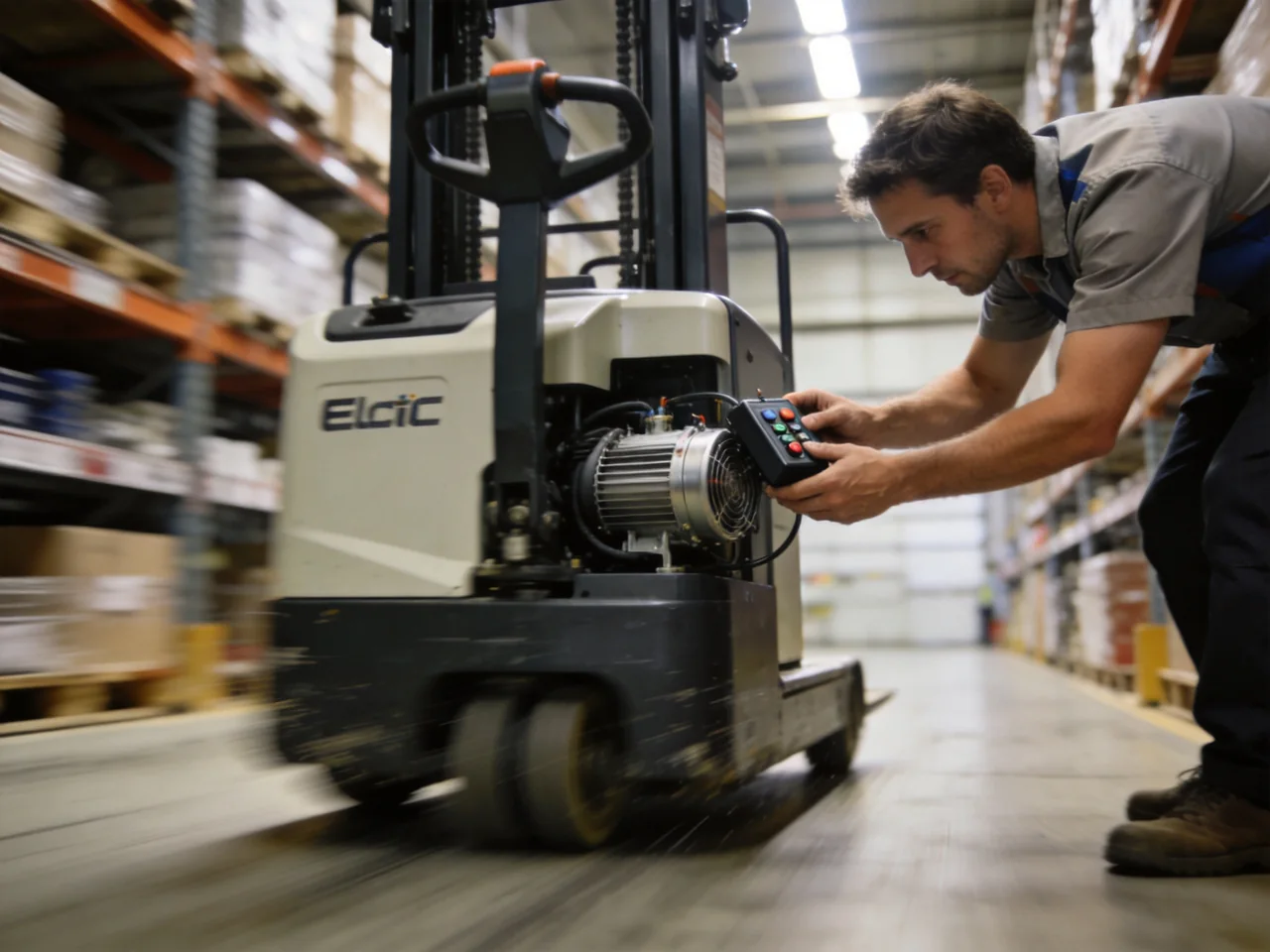
Home / Repair / Forklift Jerky or Surging Movement
Repair & Troubleshooting
Forklift Jerky or Surging Movement
An electric forklift that lurches, surges or moves jerkily is usually the throttle/accelerator sensor, motor controller, encoder or loose connections — diagnose the control signal before replacing the motor.
— Reviewed by the ForkliftIQ technical team
Jerky or surging drive on an electric forklift is a control-signal problem far more often than a motor problem. The usual suspects are the accelerator sensor, the speed encoder, the motor controller, or intermittent power connections. Read the signals first.
Jerky travel or jerky hydraulics? Make this split first
This page owns lurching and surging while the truck is travelling. If the truck drives smoothly and only the forks or mast jerk, start with the hydraulic system instead.
When the jerk happens
Likely system
Best next check
During acceleration or direction changes
Accelerator signal, direction control or traction controller
Do not change controller parameters from a generic guide. Record the exact symptom and fault codes, then use the service information for that model.
Most likely causes
Figure 1: Diagnosing jerky or surging movement — steps from this page (indicative).
Figure summary: Follow the diagnostic steps in order, working from the cheapest, most likely cause first and confirming with a test before replacing parts.
Faulty accelerator / throttle sensor — A worn or dirty throttle potentiometer/hall sensor sends a noisy signal, making speed jump or surge.
Encoder / speed sensor fault — A failing motor encoder feeds bad speed feedback, so the controller over/under-corrects and the truck lurches.
Controller fault or mis-tune — A failing controller or wrong acceleration/ramp settings cause uneven power delivery.
Loose / corroded connections — Intermittent power or signal connections at the motor, controller or battery cause momentary cut-outs and surges.
How to diagnose it
1
Read controller fault codes — encoder and throttle faults are usually logged.
2
Test the accelerator sensor output through its full travel for smooth, linear change (no dropouts).
3
Check the encoder wiring and signal at the motor; reseat connectors.
4
Inspect and torque battery, controller and motor power connections; look for heat/corrosion.
5
Only after signals check out, review controller tuning or consider the controller/motor.
⚠ Safety: Test with the drive wheels clear of the ground or in a safe area — a surging truck can move unexpectedly. Chock the wheels.
Usually a noisy accelerator sensor, a failing encoder, a controller fault, or loose power/signal connections — not the motor itself. Read fault codes first.
Can a bad encoder cause jerky movement?
Yes — the encoder gives the controller speed feedback; bad feedback makes it over-correct and the truck lurches.
Is jerky movement dangerous?
It can be — sudden surges reduce control. Take the truck out of service and diagnose before further use.
Will replacing the controller fix it?
Only if the controller is actually at fault. Rule out the throttle sensor, encoder and connections first — they fail more often.
Need the parts — fast, factory-direct?
Tell us your forklift make, model and the part you need. We ship genuine and quality aftermarket parts worldwide.