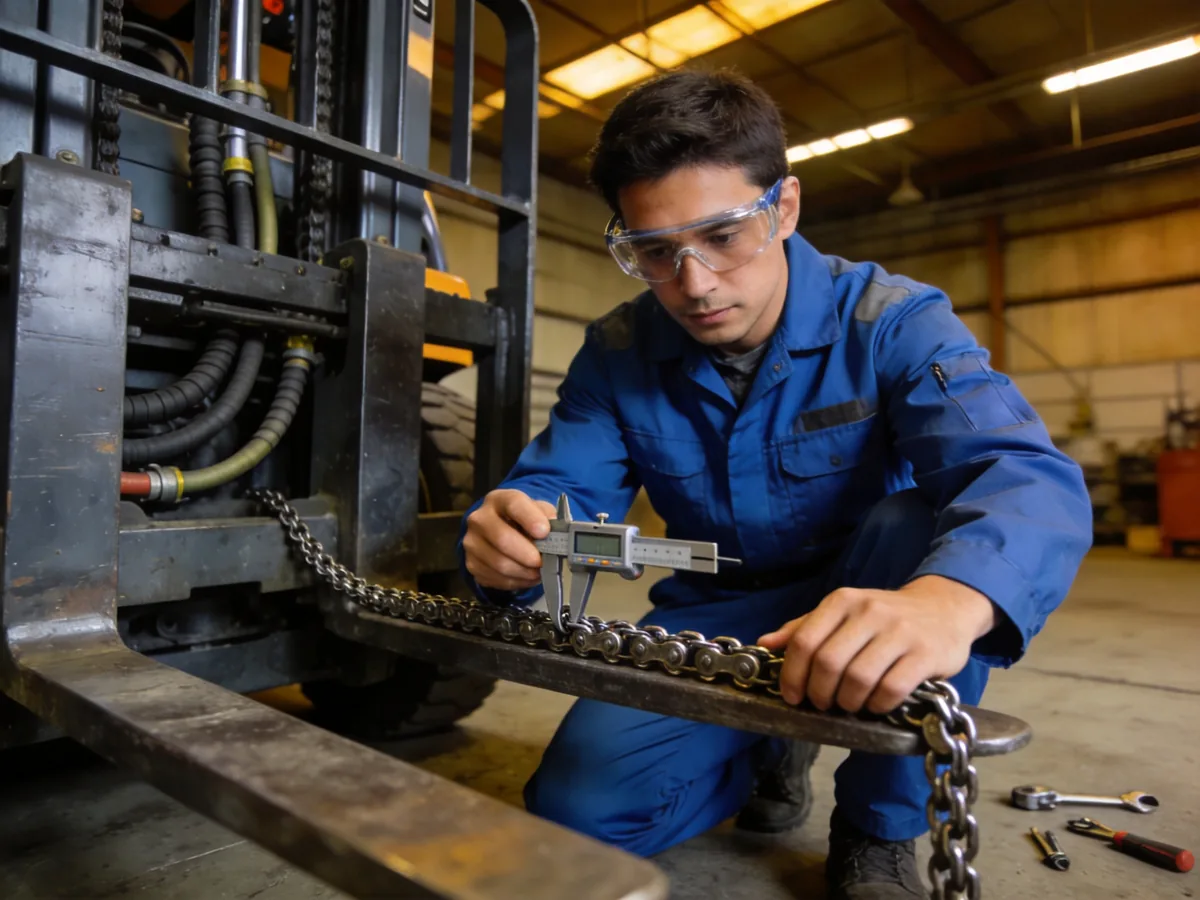
Forklift lift chain problems — stretched, loose, uneven or rusted chains — affect lift safety and mast operation. Inspect for elongation and replace chains in matched pairs before they fail.
— Reviewed by the ForkliftIQ technical team
Lift chains carry the load on a forklift mast, so wear is a safety issue, not just a performance one. The common problems are chain elongation (stretch), uneven or loose chains, rust and stiff links, and worn anchors or sheaves. Inspect regularly and replace as a matched pair.
Watch a lift-chain wear-gauge check
This demonstration shows how a technician identifies chain pitch, counts a fixed span of links and positions a wear gauge to read elongation. The moving close-ups clarify the measurement sequence before the broader chain, anchor and sheave inspection below.
Around 00:07: the gauge’s pitch marks are placed center-pin to center-pin to identify the chain size.
Around 00:27: one V is located on a pin and the technician counts the specified 25-pin span.
Around 00:41: the second V is placed on the marked pin so the wear percentage can be read in the window.
Use boundary: A gauge reading is one part of the inspection. Follow the gauge and chain manufacturer’s limits, and also inspect plates, pins, anchors and sheaves. Take cracked, seized, corroded or over-elongated chains out of service and replace paired chains together.
Most likely causes
Figure 1: Diagnosing lift chain — steps from this page (indicative).
Figure summary: Follow the diagnostic steps in order, working from the cheapest, most likely cause first and confirming with a test before replacing parts.
Chain elongation (stretch) — Links and pins wear over time, stretching the chain; once elongation reaches about 3 percent the chain must be replaced.
Uneven or loose chains — Mismatched chain tension makes the forks sit unevenly and overloads one chain.
Rust, stiff or seized links — Lack of lubrication and moisture cause stiff links that wear fast and bind on the sheave.
Worn anchors or sheaves — Worn chain anchors, sheave bearings or sheave grooves damage the chain and cause noise.
How to diagnose it
1
Inspect chains for stretch using a chain gauge or by measuring a set number of links against spec.
2
Check both chains sit at equal tension with the forks level and lowered.
3
Look for rust, cracked plates, stiff or turned links, and corrosion.
4
Inspect the chain anchors, sheaves and sheave bearings for wear.
5
Lubricate chains with the correct chain lube, never grease that traps grit.
6
Replace stretched or damaged chains as a matched pair, then re-set tension.
⚠ Safety: Worn lift chains can fail and drop the load — never work or stand under raised forks, and take any forklift with cracked, seized or over-stretched chains out of service immediately.
Replace chains when elongation reaches about 3 percent, or if you find cracked plates, seized or turned links, or corrosion. Always replace in matched pairs.
Why are my forklift forks uneven?
Uneven forks usually mean the two lift chains are at different tension or one has stretched more than the other; re-tension or replace as a pair.
How do I check forklift chain stretch?
Use a chain wear gauge or measure a fixed number of links and compare to the new-chain length; about 3 percent elongation means replacement.
Should I grease forklift lift chains?
Use proper chain lubricant, not heavy grease — grease traps grit and accelerates wear. Keep chains clean and lubed to prevent stiff links.
Need the parts — fast, factory-direct?
Tell us your forklift make, model and the part you need.