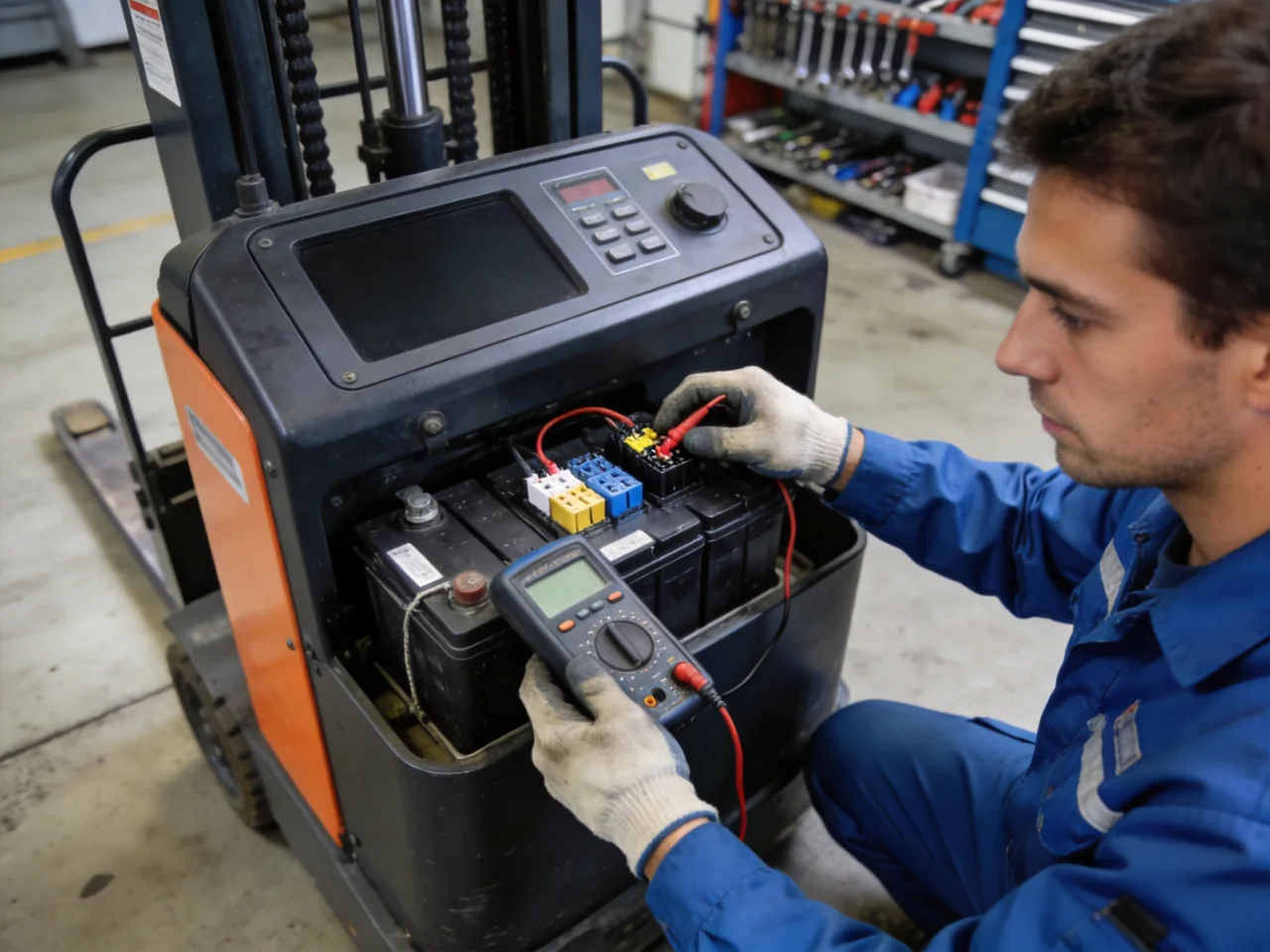
An electric forklift that's completely dead — no dash, no power on key-on — is usually the battery connection, main fuse, key switch or emergency stop, not a major failure. Work from the simple causes up.
— Reviewed by the ForkliftIQ technical team
A no-power electric forklift is almost always an interrupted supply, not a blown controller. Check the battery connector, main fuse, emergency-stop and key switch before anything expensive — these account for most dead-truck calls.
Watch a no-power check on a Toyota 7FBEU18
This 82-second field example shows how a technician narrows a completely dead electric forklift from the battery pack toward the low-voltage control circuit. It adds a useful visual reference for the battery, key-switch feed and fuse-panel checks described below.
Around 00:19–00:37: the technician checks battery condition and measures pack voltage before moving downstream.
Around 00:39–00:45: no feed is found at the key switch, which keeps the search on the supply side of the control circuit.
Around 00:56–01:10: the fuse-panel area is opened; the fuses pass inspection and a broken connection or component is found nearby.
Model boundary: This is one Toyota 7FBEU18 case, not a universal fuse-location guide. Isolate the battery before opening panels, use the service manual for connector and fuse locations, and do not replace a fuse until the cause of any failure is understood.
Most likely causes
Figure 1: Diagnosing turn on — steps from this page (indicative).
Figure summary: Follow the diagnostic steps in order, working from the cheapest, most likely cause first and confirming with a test before replacing parts.
Battery disconnected or flat — An unplugged/corroded battery connector or a fully discharged pack gives no dash and no power.
Blown main fuse — A blown main power or control fuse cuts everything; it often blows for an underlying reason.
Emergency stop / seat switch — An engaged E-stop or a faulty seat (presence) switch keeps the truck powered down by design.
Key switch or wiring fault — A failed key switch, broken harness wire or bad ground breaks the control circuit.
How to diagnose it
1
Confirm the battery is charged and the connector is fully seated and clean.
2
Check the main power and control fuses for continuity; replace and watch if it re-blows.
3
Release the emergency-stop button and confirm the seat/presence switch closes when seated.
4
Test the key switch for output on each position and check the main ground connection.
5
If supply is good but it's still dead, check the controller's keyswitch/B+ input before replacing it.
⚠ Safety: Disconnect the battery before probing fuses or wiring, and never bypass the seat switch or E-stop — they are safety interlocks.