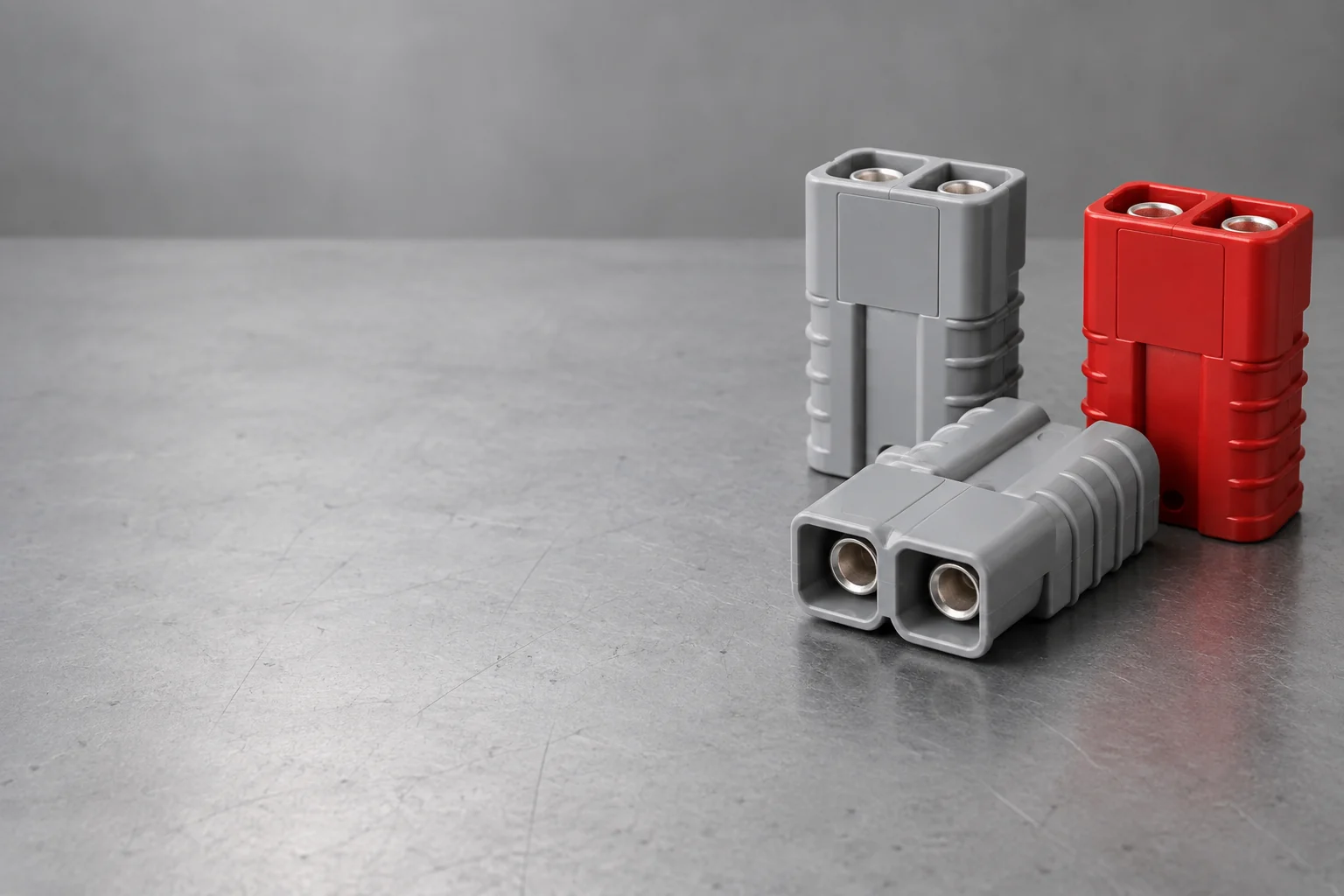
Identify the complete battery-connection assembly, housing family, contact references and equipment interface. Housing colour, appearance or a family name alone cannot establish the electrical rating or an approved mating arrangement.
A connector enquiry may concern a housing, a contact set, a cable assembly or a complete battery connection. State which scope is required and which existing pieces a proposal expects to retain. Include the truck and battery identity and accessible connector markings. A catalogue photograph cannot establish the supplied contents. Ask the supplier to itemise the proposed assembly and its documents. This page helps identify battery-to-equipment requirements; charger-side lead requirements have a separate linked enquiry route.
More guidance for this step
Retain the family and full component references
Names such as SB175 or SB350 are useful research examples but are not universal specifications or cross-reference approvals. Retain the exact housing, contact and assembly references, including suffixes, and request the appropriate manufacturer drawing. Ask how each proposed component relates to the documented installation. Do not select a contact from housing appearance alone or assume that a similarly named connector is the same manufacturer product. Keep a written account of the actual item, condition and included scope with the enquiry.
Do not treat colour as a complete voltage rule
Anderson’s SB175 material describes colour-coded mechanical keying and a black keyless housing. That example is enough to show why colour alone should not be treated as proof of voltage or an approved pairing. Ask for the documented housing family and mating requirements of the actual components. Do not apply one family’s keying arrangement to all battery connectors or to another manufacturer. The illustration uses plain generic housings for orientation; their colour communicates no installed voltage or confirmed technical requirement.
More guidance for this step
Compare contact and assembly documentation
Request the documents identifying the housing and contact combination, intended cable specification, assembly scope and applicable equipment requirements. Keep these details separate from a headline family name or current description. A rating must relate to the actual documented proposal and its conditions. This guide gives no contact-selection formula, termination procedure, polarity test or rewiring instruction. Photographs of accessible markings support discovery, while the proposed complete connection and its equipment application still require competent technical review.
Use a catalogue lead without transferring brand claims
Decha’s readable search results include named forklift power-connector and battery-cable entries as well as unrelated connectors. Preserve the wording and reference of the relevant electrical entry rather than treating every connector result as a traction component. Its brand wording does not prove original manufacture, dealer authorisation or current stock. Ask for the exact offered assembly and supporting documents. Clarify whether the response concerns a complete cable connection or separate components, and record any difference from the installed equipment requirements.
Keep observed condition separate from a parts diagnosis
Describe visible damage or an observed symptom only as context for the request. A photograph or heat complaint cannot independently establish the cause or justify a generic replacement instruction. This page does not provide live inspection, contact replacement, pairing or connection procedures. Preserve relevant service records and refer technical assessment to the appropriate documents and competent person. Compare the exact proposal, unresolved differences, quantity, destination and commercial terms after the assembly scope is clear; a quotation is not itself approval to install.
Supplier profiles for this requirement
These company routes are tied to readable manufacturer or company-controlled material reviewed on 3 October 2026. Use the stated scope to begin a shortlist. A profile does not establish current stock, certification, authorisation or a match for your truck.
The readable catalogue includes named forklift power connectors, charging plugs and battery-cable assemblies. Use the precise entry as an enquiry lead; its brand wording does not establish genuine origin, authorisation, stock or approved interchangeability.
For additional candidates, use the parts supplier directory. Ask each supplier to return the exact proposed item, condition, included documents, unresolved differences, quantity, destination and current delivery terms. Keep technical acceptance separate from commercial availability.
Purchasing questions
Does connector colour prove battery voltage?
No. Identify the manufacturer family and documented keying and application requirements; colour alone is insufficient.
Does an SB175 label establish a complete assembly rating?
No. Obtain the documents for the exact housing, contact and assembly combination and its stated conditions.
Are catalogue connectors necessarily battery connectors?
No. Search results may include hydraulic, air or signal connectors. Retain the actual electrical assembly reference and scope.
Does a catalogue brand name prove genuine supply?
No. Ask the supplier to identify the offered manufacturer, condition, evidence and current commercial terms.
Primary-source notes · reviewed 3 October 2026
The references below support the stated category and identification examples. Manufacturer marketing statements are not treated as independent tests. No model-specific operating values, repair procedures or performance promises are inferred for another machine.
Anderson SB175 named housing and keying example; no generic voltage inference: https://www.andersonpower.com/product/sb175-housing-black-keyless/
Decha named electrical connection and battery-cable catalogue leads: https://www.dechaparts.com/?s=connector&post_type=product
Prepare a parts matching request
Send the equipment identity, complete component reference, existing drawings or label photos, requested scope, quantity and destination. Mark missing information unknown and ask suppliers to answer the same written requirement.