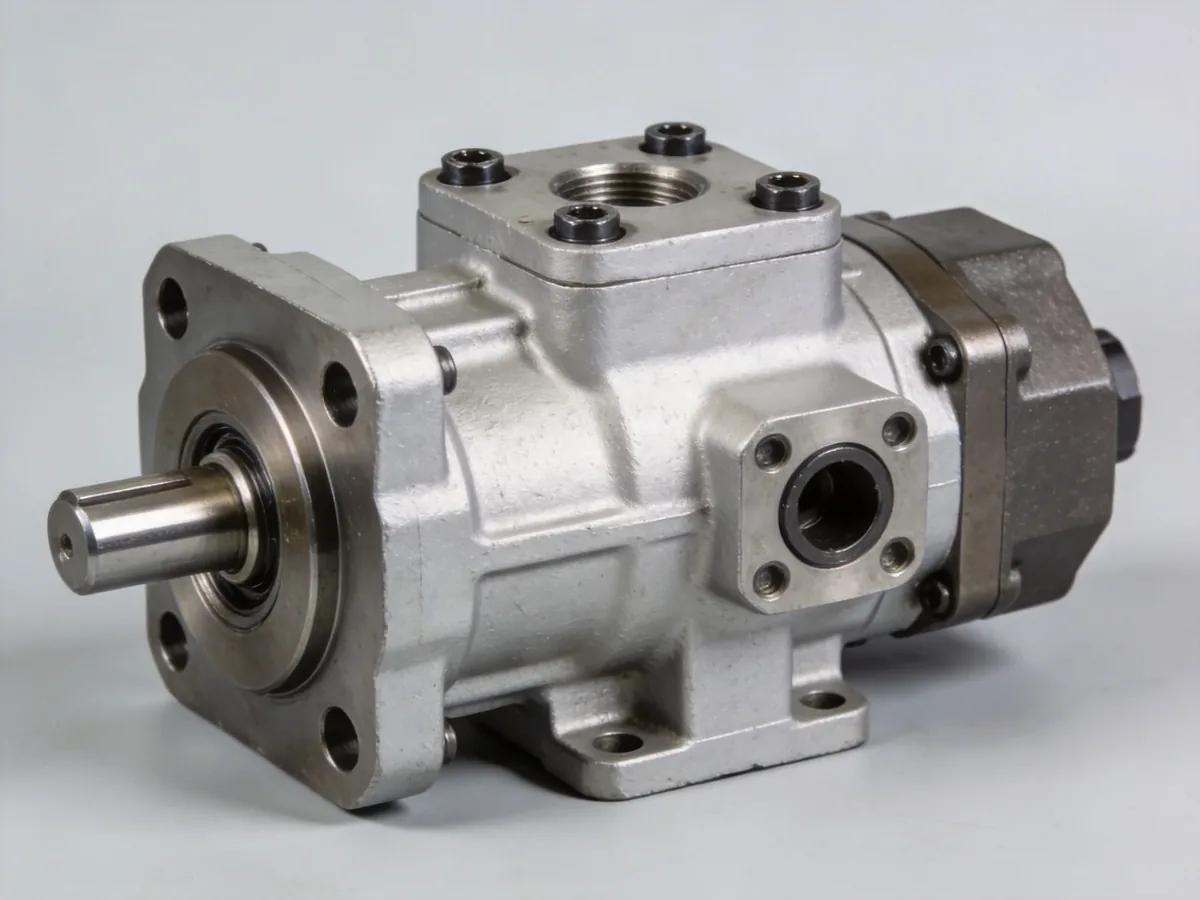
Use the complete pump reference, drive interface and original hydraulic application to define a replacement enquiry. A gear, vane or piston category helps locate documents; it does not establish a replacement by itself.
Record the truck manufacturer, model and serial number, together with the original pump and equipment part references. State the documented hydraulic function and the requested supply scope. Do not assume every forklift uses the same pump design or that the most common seller category describes your machine. A lift problem is not proof of pump failure; retain a service-established component requirement where one exists.
More guidance for this step
Preserve mounting and drive information
Use the original drawing or parts record to retain the flange, shaft, coupling and orientation details. Include photographs that can be obtained safely without opening or removing equipment for this enquiry. A housing outline can resemble another pump while its drive and mounting differ. Ask the supplier to return a drawing of the proposed variant and mark differences from the original assembly rather than confirming fit from appearance alone.
Keep displacement and rating conditions together
Parker’s P1M page separates displacement variants, control options and ratings with stated conditions. This illustrates why an isolated maximum figure does not describe the full purchasing requirement. It is not evidence that a P1M pump belongs in your forklift. Keep the applicable original specification, fluid requirement and duty information with each offered variant. Do not copy general pressure or speed values into a replacement instruction.
More guidance for this step
Describe ports and controls from records
Retain the original port identities, connection drawing and control designation. Ask whether an offer includes control devices, adapters, seals and connection hardware or only the pump body. Avoid treating similar port sizes as evidence that the circuit arrangement is identical. The proposed unit should be tied to a documented assembly reference and its interfaces, with unresolved differences explicitly returned to the buyer for review.
Use the documented supplier categories
Eternal Hydraulic’s website explicitly includes forklift gear pumps alongside other pump categories. This is a relevant discovery route, not approval of every pump marketed under a replacement-brand description. Ask for the exact proposed reference, application evidence and origin. Broad hydraulic capability does not establish current forklift-specific stock. Keep the manufacturer reference and the supplier’s commercial item code as separate fields in the enquiry.
Separate repair and replacement scope
A new pump, exchanged pump and repair assessment need different commercial descriptions. Ask what is included, what records support identification and who accepts responsibility for the proposed application. Include quantity, destination and delivery terms after technical scope is established. This page provides no pressure-testing, relief-setting, disassembly or fault-isolation procedure. Any service conclusions must come from the applicable machine assessment, not a general pump purchasing guide.
Supplier profiles for this requirement
These company routes are tied to readable manufacturer or company-controlled material reviewed on 2 October 2026. Use the stated scope to begin a shortlist. A profile does not establish current stock, certification, authorisation or a match for your truck.
The company website explicitly lists forklift gear pumps and directional, modular, proportional and other hydraulic valves. Replacement-brand descriptions are supplier claims, not proof of original-brand authorisation or a particular machine match.
For additional candidates, use the parts supplier directory. Ask each supplier to return the exact proposed item, condition, included documents, unresolved differences, quantity, destination and current delivery terms. Keep technical acceptance separate from commercial availability.
Purchasing questions
Does failure to lift prove a bad pump?
No. Retain the symptom until a model-specific assessment identifies the component.
Is a similar mounting flange sufficient?
No. Preserve shaft, ports, controls and the complete assembly identity.
Can P1M ratings be used for my truck?
No. The source illustrates variant documentation, not a forklift replacement specification.
Does the supplier route prove stock?
No. Request the exact item, application evidence and current commercial availability.
Primary-source notes · reviewed 2 October 2026
The references below support the stated category and identification examples. Manufacturer marketing statements are not treated as independent tests. No model-specific operating values, repair procedures or performance promises are inferred for another machine.
Manufacturer variant and rating-condition example: https://discover.parker.com/p1m
Send the equipment identity, complete component reference, existing drawings or label photos, requested scope, quantity and destination. Mark missing information unknown and ask suppliers to answer the same written requirement.
Use these guides to organize symptoms and identify the documents needed for a component enquiry. They do not establish a diagnosis, safe repair procedure or replacement compatibility.