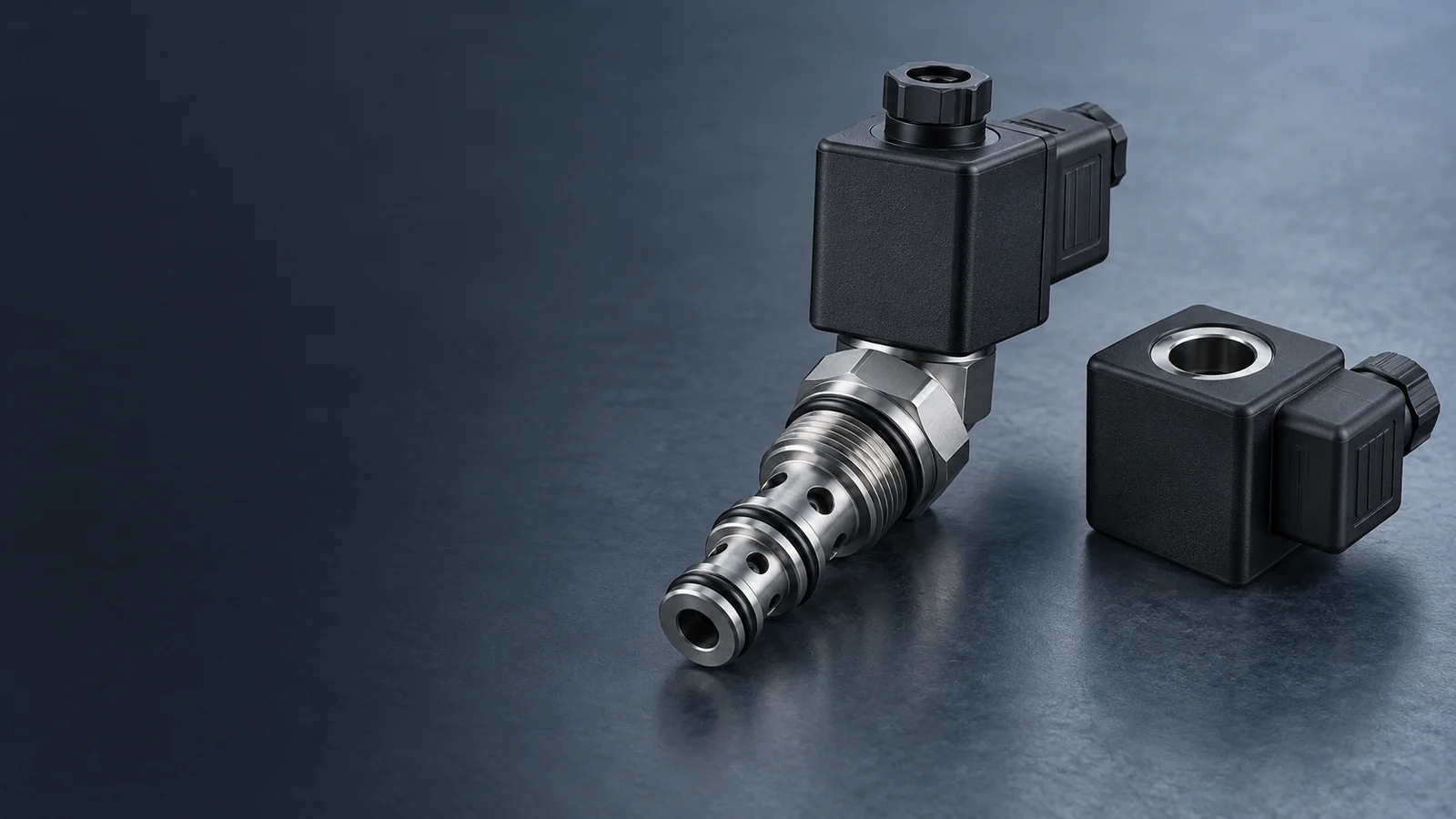
Separate a hydraulic solenoid valve assembly from its coil, cartridge and main control-valve bank. Match the request using the complete valve and coil codes, documented circuit function, connection and mounting scope. Coil voltage or similar appearance alone cannot establish a replacement.
Begin with the truck plate and the full valve identification already available in the parts or service record. Preserve the valve-body code, coil code and ordering suffixes separately. Say whether the request covers a complete valve, cartridge, coil, connector or accessory. A picture of a valve bank should not turn a coil enquiry into an order for the whole bank. Use the complete control-valve page when the requirement is the main assembly rather than a component.
More guidance for this step
Use hydraulic references for hydraulic requirements
The Danfoss hydraulic solenoid-valve catalogue separates model-code fields for coils, connectors, seals and housings in its ordering examples. Eternal’s DSG page also presents spool, coil and connection fields for that product family. These documents support retaining a complete ordering identity. They do not establish that either example belongs to your forklift. Avoid importing refrigeration or general industrial valve recommendations into a truck application merely because each product is called a solenoid valve.
Keep coil identity separate from valve function
Request the documented coil supply type, complete reference, connector and applicable valve relationship. Ask whether the coil, retaining hardware, seals and plug are included or separate. A matching voltage marking does not identify every option, nor does it define what the hydraulic valve does in the circuit. Preserve the proposed coil-to-valve mapping in writing. Do not assume that a seller’s universal-coil description establishes mechanical or electrical compatibility with an installed assembly.
More guidance for this step
Resolve the hydraulic configuration
For a complete valve or cartridge, request the referenced circuit symbol, de-energised function, port or cavity designation, mounting drawing and applicable documented operating envelope. Record the source of each requirement; leave unknowns visible. A supplier should explain how its full ordering code answers that requirement. Do not infer a normally open or normally closed function from the illustration, connector or coil. The relevant technical reviewer must resolve any function or assembly difference before purchasing approval.
Specify accessories and substitution evidence
Ask whether the proposal includes the housing, coil, connector, retaining parts and specified seals. Compare a bare cartridge with another bare cartridge, rather than with a complete assembly priced under the same short description. For an alternative code, require the original-to-proposed mapping and the source documents supporting it. An advertised dimensional standard or interchangeability statement is a supplier claim until the application-specific review is complete. No fit or compliance conclusion follows from catalogue appearance.
Keep fault reports outside the sourcing conclusion
An inability to lower, drift or an electrical fault report can be useful background for the service team, but this guide does not attribute those symptoms to a coil or valve. It gives no pressure-adjustment, bypass, disassembly or energising procedure. The supplier profile below supports a documented valve enquiry; separate coil inventory and suitability for your forklift remain open. Compare condition, documentation, warranty, quantity and delivery only after the requested assembly and technical scope are clear.
Supplier profiles for this requirement
These company routes are tied to readable manufacturer or company-controlled material reviewed on 3 October 2026. Use the stated scope to begin a shortlist. A profile does not establish current stock, certification, authorisation or a match for your truck.
Its directional-valve catalogue and DSG product page document solenoid-operated valve categories and ordering fields. This is a valve-assembly enquiry route. Separate coil or cartridge availability, forklift application approval and an exact cross-reference remain to be confirmed.
For additional candidates, use the parts supplier directory. Ask each supplier to return the exact proposed item, condition, included documents, unresolved differences, quantity, destination and current delivery terms. Keep technical acceptance separate from commercial availability.
Purchasing questions
Can I select a replacement coil by voltage alone?
No. Resolve the full coil code, supply type, connector, mechanical relationship and documented valve application. A voltage marking is only one identification field.
Is a cartridge quotation the same as a complete valve quotation?
No. State whether the housing, coil, connector, retaining parts and specified seals are included. Compare equivalent supply scopes.
Does a lowering problem prove a solenoid valve has failed?
No. A symptom does not establish the defective component. Keep the service assessment separate from purchasing identification and application approval.
Does the supplier route confirm separate-coil stock?
No. The reviewed material supports a valve-assembly research route. Separate coil or cartridge availability and exact application suitability require a current response.
Primary-source notes · reviewed 3 October 2026
The references below support the stated category and identification examples. Manufacturer marketing statements are not treated as independent tests. No model-specific operating values, repair procedures or performance promises are inferred for another machine.
Manufacturer hydraulic solenoid catalogue; separate ordering-code fields: https://assets.danfoss.com/documents/latest/587851/BC332375861112en-000205.pdf
Company DSG valve ordering fields and assembly scope: https://etlhyd.com/product/hydraulic-valve/dsg-series-solenoid-directional-control-valve/
Prepare a parts matching request
Send the equipment identity, complete component reference, existing drawings or label photos, requested scope, quantity and destination. Mark missing information unknown and ask suppliers to answer the same written requirement.
Use these guides to organize symptoms and identify the documents needed for a component enquiry. They do not establish a diagnosis, safe repair procedure or replacement compatibility.