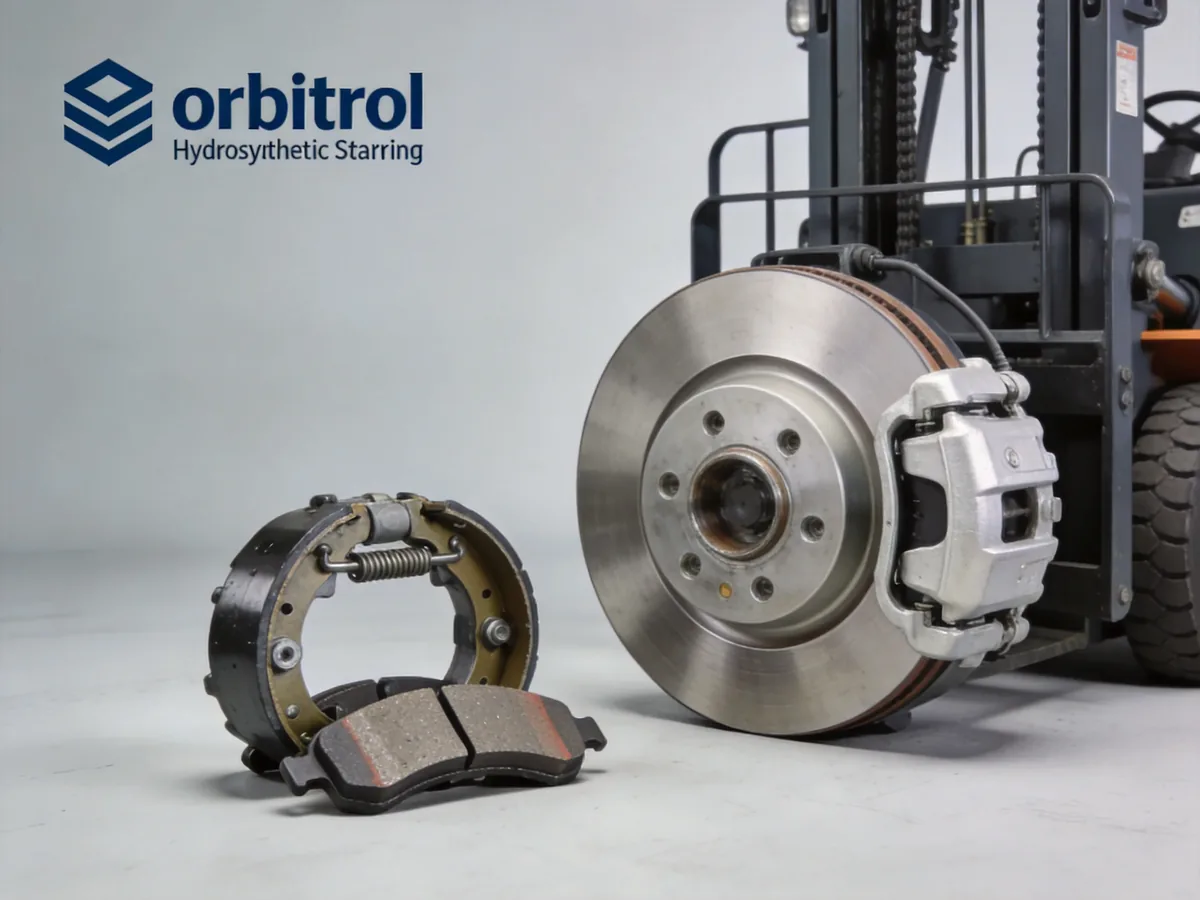
Steering and braking enquiries need the exact function and assembly identity. Separate a steering unit or cylinder from a service brake or holding brake. A handling symptom cannot establish which part failed or approve a substitute.
Hydraulic steering units, steering cylinders and electronic steering inputs belong to different procurement routes. Danfoss’s steering-unit range includes several families and identifies forklift applications for particular variants. Curtis also describes steering-sensor units for steer-by-wire systems. These examples prevent the assumption that every electric forklift uses one steering arrangement. Ask for the architecture applicable to the identified truck; do not select an orbitrol or sensor simply from the equipment’s power source.
More guidance for this step
Distinguish braking functions
Service-brake components and holding or parking-brake assemblies serve different requests. Kendrion’s industrial-truck information describes spring-applied holding-brake products for several vehicle classes, with distinct model configurations. That is product-family evidence, not proof that every forklift has an electromagnetic parking brake or that one unit is universally suitable. Record the full original brake identifier and the responsible service organisation’s component description. Keep shoes, drums, friction parts and complete brake assemblies as separate quotation lines.
Prepare the matching documentation
For steering, collect the unit or cylinder reference, applicable ports and mounting drawing, truck serial number and system document reference. For braking, preserve the assembly identity and any existing brake-component numbers, installation drawing and documented electrical interface where relevant. Specify whether the request is for a complete unit, friction components, an actuator, a handle or a repair kit. Have the supplier state all included items, differences and assumptions. Accessible photographs help identify the request but do not certify performance.
Do not convert symptoms into a repair instruction
Heavy steering, weak stopping, failure to release or failure to hold does not isolate one worn part. The previous generic cause lists have been removed from this procurement route. Record the observation and refer the equipment to the appropriate service process; pressure checks, brake adjustment, circuit work and functional release require model-specific instructions and qualified responsibility. This page is not an inspection or return-to-service standard. A supplier’s product category is equally unable to establish that the truck is safe to operate.
Ask for a traceable component offer
Request the exact assembly, applicable drawing or catalogue reference, condition and supplied contents. The Zhaohui site contains forklift shoes and repair-kit categories alongside other vehicle products; narrow the enquiry to the forklift assembly rather than assuming every category applies. Ask for the current proposed model and documented application. Compare technical response and commercial availability separately, and route hydraulic cylinder questions to the hydraulic system guide when more component detail is required.
Supplier profiles for this requirement
These company routes are tied to readable manufacturer or company-controlled material reviewed on 2 October 2026. Use the stated scope to begin a shortlist. A profile does not establish current stock, certification, authorisation or a match for your truck.
The manufacturer website lists forklift brake shoes, brake assemblies, parking-brake handles and repair kits. These are discovery categories; ask for the exact assembly, contents and drawing applicable to your equipment.
For additional candidates, use the parts supplier directory. Ask each supplier to return the exact proposed item, condition, included documents, unresolved differences, quantity, destination and current delivery terms. Keep technical acceptance separate from commercial availability.
Reviewed supplier routes for this system
Official website scopes reviewed on 4 October 2026. Product families are enquiry starting points; they do not establish available stock, fitment or vehicle approval. Use the profile to distinguish complete assemblies from component and service routes.
Anqing HELI Axle — Steering and drive axles. Confirm the exact offered assembly and application before ordering.
Zhejiang Changda — Forklift clutch assemblies. Confirm the exact offered assembly and application before ordering.
Hengshui Zhaohui — Forklift brake shoes and parking-brake enquiries. Confirm the exact offered assembly and application before ordering.
Does heavy steering identify a defective orbitrol?
No. It is an observation for the service assessment. Identify the actual steering architecture and documented replacement requirement before ordering.
Are service and holding brakes the same request?
No. State the function and complete assembly identity so suppliers can distinguish the components and the quoted scope.
Can a similar brake housing be used as a substitute?
Housing similarity is insufficient. The supplier must document the specific mechanical, electrical and application match; this page does not approve installation.
Does a supplier listing approve brake safety?
No. The listing records published product scope. It does not establish performance, vehicle integration, inspection results or return-to-service approval.
Primary-source notes · reviewed 2 October 2026
The references below support the stated category and identification examples. Manufacturer marketing statements are not treated as independent tests. No model-specific operating values, repair procedures or performance promises are inferred for another machine.
Steering family and application distinctions: https://www.danfoss.com/en/products/dps/steering/hydraulic-steering/hydraulic-steering/hydraulic-steering-units/
Send the equipment identity, complete component reference, existing drawings or label photos, requested scope, quantity and destination. Mark missing information unknown and ask suppliers to answer the same written requirement.