Where this category makes sense
Container terminals, intermodal yards and heavy logistics sites with engineered travel and stacking plans.
A heavy mobile handler using a telescopic boom and spreader or attachment to place containers or heavy units in rows.
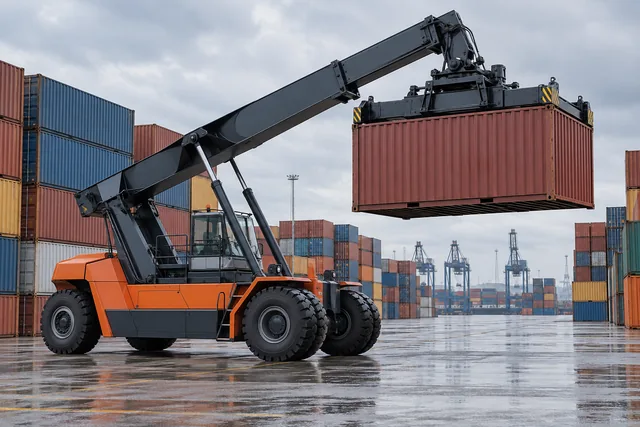
Container terminals, intermodal yards and heavy logistics sites with engineered travel and stacking plans.
Treating it as an ordinary forklift or ignoring container row, stack, pavement and spreader requirements.
A useful supplier response should address the same operating inputs. Similar capacity labels do not make two configurations technically comparable.
These internal links lead to individual supplier profiles already reviewed by ForkliftIQ. They are research routes, not current-stock claims, rankings or endorsements.
Counterbalance, heavy forklift and port-handling manufacturer profile.
Open supplier profile →Port and heavy material-handling equipment profile.
Open supplier profile →Manufacturer profile covering counterbalance, warehouse, heavy and specialised equipment.
Open supplier profile →Describe the load before describing the truck. Record maximum and typical weight, dimensions, load centre, stability and whether the load is palletised, suspended, clamped, unusually long or otherwise difficult to support. State the required lift, reach or transport movement and identify the attachment that will be installed. Capacity must be evaluated for the complete configuration rather than a bare chassis.
Document the route and work area. Include aisle and turning space, rack and door openings, floor or ground condition, gradients, dock plates, overhead restrictions, pedestrian interfaces, operating temperature, weather and contaminants. State daily and peak operating hours, travel distance, lift cycles and shift pattern. These inputs determine chassis, tyre, cooling and energy requirements.
Require the exact model, rated-capacity basis, load chart or residual-capacity evidence, overall dimensions, mast or boom data, tyres, steering and brake arrangement, battery and charger or engine specification, attachment, safety options and environmental limits. Ask the supplier to identify every assumption and exclusion.
Normalize commercial scope before comparing price. Record freight basis, import documentation, commissioning, operator or technician training, included spare parts, warranty period, exclusions, claim route and the legal entity responsible for support. A cheaper quotation may omit energy equipment, attachment functions, documentation or after-sales work.
Request the preventive-maintenance schedule, consumable and wear-parts list, recommended initial spares, parts-identification method and normal lead times. Clarify who can access diagnostics, parameters and software. For electric equipment, include battery, charger, connector, controller and communication details. For combustion equipment, include engine, emission, filtration and cooling configuration.
If replacement parts will be sourced later, preserve the full truck model and serial or chassis number, configuration and original component labels. Photograph part numbers, connectors, ports, mounting points and dimensions. Similar appearance and a broad category name are not sufficient compatibility evidence.
A manufacturer, export company, regional office, dealer and service agent may have different responsibilities. Confirm which legal entity will quote, invoice, receive payment, deliver, commission and honour warranty claims. Where authorization affects software, warranty or parts access, obtain current written evidence from the brand or network.
The profiles linked above were included because a company-controlled website or official network source showed a relevant equipment route. ForkliftIQ has not audited current production, stock, certificates, technical suitability, commercial reliability or after-sales performance. Treat every profile as a structured research starting point.
The final decision depends on a documented application and a current model-specific offer.
No. Capacity, dimensions, energy system, stability, controls and environmental limits vary by model and configuration.
No. The links lead to researched company profiles whose reviewed sources show related equipment scope. Request a current model-specific quotation.
Send the load, load centre, lift or reach, aisle and site limits, duty cycle, energy constraints, attachment, quantity, destination and required delivery date.