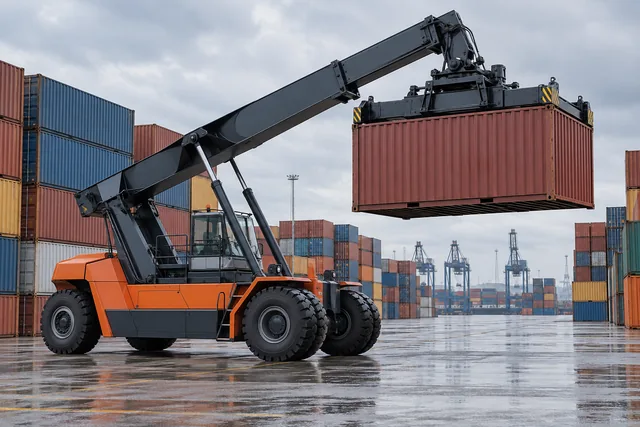
Named-model research
XCMG XCS45
telescopic-boom container reach stacker in the XCMG manufacturer product record. Review the container-position load chart before applying the 45 t headline rating.
Reviewed 2026-09-30 · manufacturer claims remain attributed · quotation-specific evidence requiredEditorial category illustration; not a photograph, engineering drawing or performance record of this model.
Published scope
Start with the claim, then identify the offered equipment.
The facts below summarize the source reviewed by ForkliftIQ. They do not prove current availability, regional configuration or suitability for a particular site.
Buyer interpretation
Review the container-position load chart before applying the 45 t headline rating.
A model name helps organize research. Technical approval still depends on one exact configuration and a written operating requirement.
Application boundary
A reach stacker uses a boom and spreader to position containers. The maximum rated load is not a capacity for every reach, row or stacking position. Obtain the model-specific chart and container conditions for the proposed operating case.
Configuration evidence
The XCS45 and XCS45U have separate manufacturer pages and dimensions. This profile uses XCS45 and does not transfer the U version's market or engine statements. Identify the exact offered code and regional package.
Operating-system check
The page labels a turning measure that needs clarification before route design. This profile does not convert that entry into an assumed radius. Request the configuration drawing and swept-path information for the yard.
Information to measure before requesting this model
Record container sizes, gross mass, required rows and levels, rail or truck interfaces, travel route, surfaces, gradients, turning areas and obstacles. Ask the responsible parties to review ground support and the loaded machine case.
Require the offered boom, spreader, engine, tyres and control package. Keep the load chart and dimensioned yard route with the quotation. Do not treat maximum load and maximum lift as simultaneous capabilities.
Questions for the quotation
- Which chart covers our container size, mass, row and stacking position?
- Which XCS45 engine and destination package are offered?
- Which spreader and twistlock interface are included?
- Which yard drawing, axle-load record and service plan accompany the offer?
Documents to request
Ask for the complete model and option codes, a dated model-specific data sheet, dimensions, the configuration-specific load chart, engine and fuel data, lifting-tool approval, tyre specification, operator and maintenance manuals, scheduled service requirements and the applicable destination-market conformity records. The contracting party should identify who commissions the truck, provides training, supports diagnostics, supplies parts and carries warranty responsibility.
How to compare an alternative
Build one comparison sheet and hold the operating case constant. Use the same load, load centre, lift height, attachment, aisle or route, gradients, floor, temperature, shifts and energy-supply plan for every candidate. Ask suppliers to show where each quoted value comes from and whether it is standard, optional, calculated, tested or dependent on a market package.
Separate truck price from the operating system around it. Include fuel and site work, engine maintenance assumptions, tyres, scheduled service, diagnostic access, software or telematics fees, training, commissioning, freight, spare parts and expected downtime support. A lower equipment price can produce a higher operational cost when these boundaries are omitted.
Commercial and delivery boundary
Record the legal seller, Incoterm, delivery location, included options, excluded installation work, document language, acceptance method, warranty start, response time and responsible service entity. Require written change control when the supplier substitutes a mast, battery, charger, tyre, controller or software package after the technical review.
Parts and service identity
The family name is not sufficient for a parts match. Preserve the data plate, full model, serial number, lifting system and tool details, engine, controller and display labels, old component number, connectors, ports, mounting points and dimensions. Ask the source of every proposed replacement: catalogue record, drawing, supersession notice or written manufacturer confirmation.
Container position controls the comparison
State the row, level and container size for each required move. The supplier should identify the relevant point on a chart for the offered boom and spreader. A headline 45 t value does not resolve a second-row or extended-reach requirement.
Keep the same position and container mass across competing offers. Record exclusions and ground-support assumptions. Agree the representative moves and documents used at commissioning before accepting a proposal.
XCS45 and XCS45U remain distinct
The manufacturer publishes separate records for these codes. Their dimensional and market statements should not be combined into one preferred specification. Require the full truck code and the dated sheet associated with the delivered machine.
Ask the responsible seller to identify engine, regional records, software and spreader options. A statement about another market version does not prove conformity of the proposed XCS45. Preserve the actual documentation with the transaction.
Yard and infrastructure requirements
Review the complete loaded route, turns, obstructions and ground conditions. Ask for axle loads and the relevant swept-path drawing. The site team should assess the yard with the exact machine, load and operation rather than using overall dimensions alone.
Record service access, recovery arrangements and commissioning responsibility. The public page does not establish suitability for a particular pavement, gradient or terminal layout. Keep those questions in the written operating brief.
Spreader and service identity
Preserve spreader model, twistlock assembly, boom, hydraulic, engine and control references. A container-handling component can require dimensions, function and communication details in addition to the machine code.
Request diagnostics, instructions and replacement-parts support for the exact configuration. Compare the masted container-handler route separately; it has a different lifting mechanism and should not inherit reach-stacker capacity claims.
Evidence boundary
ForkliftIQ has not inspected or tested this truck. Published capacity, dimensions, energy and software statements remain attributed to the manufacturer source. Current availability, exact configuration, regional documentation, dealer authority, lead time, field performance and warranty must be confirmed in writing for the offered truck.
Primary manufacturer source reviewed
https://www.xcmg.com/product/pro-detail-47650.htmNext step