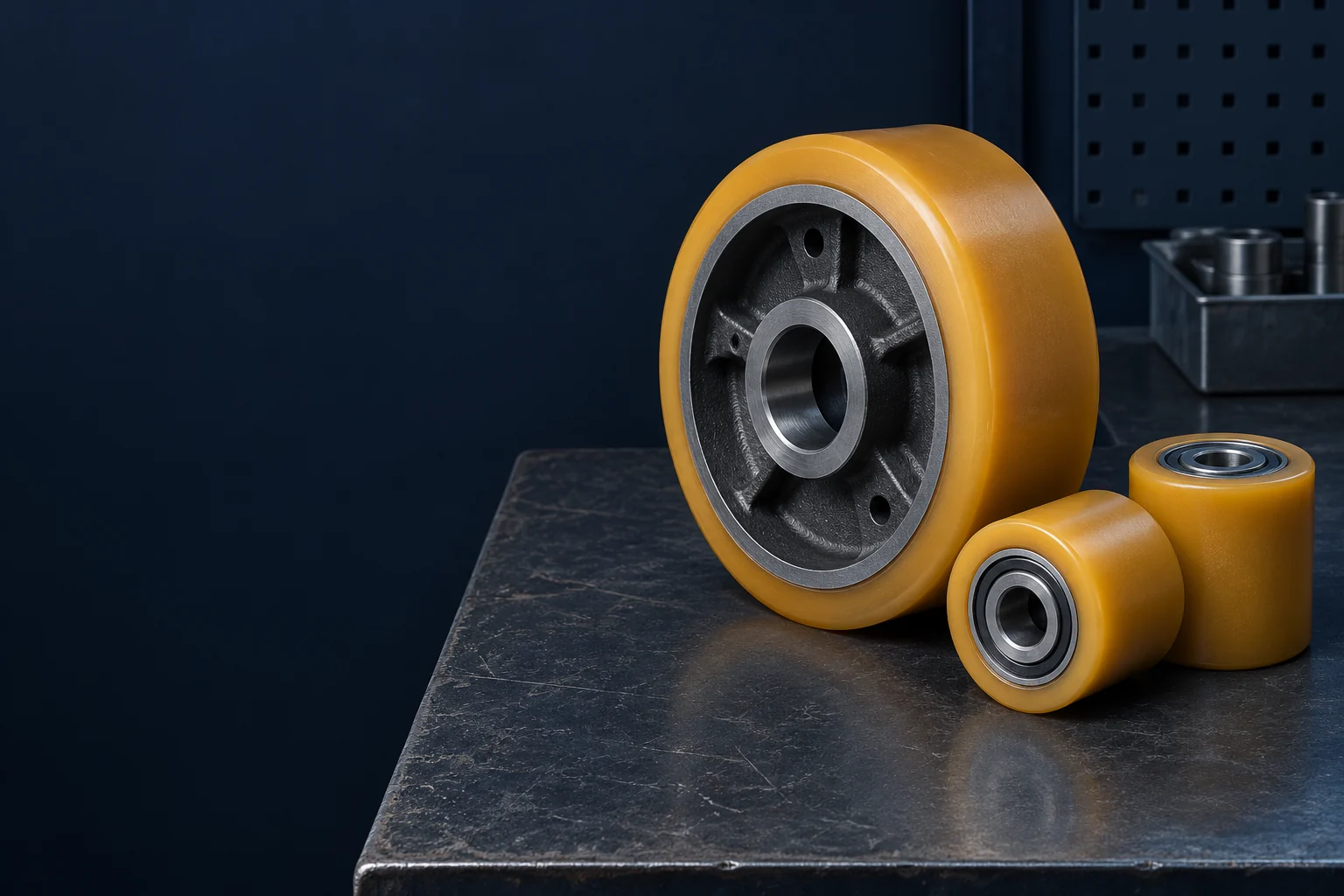
Identify a warehouse truck load wheel, drive wheel or roller from the exact equipment, assembly position and complete reference. Separate polyurethane wheel assemblies from rubber tires and press-on bands. Preserve the hub, bearing and mounting records; diameter, color or truck voltage alone does not establish an interchangeable wheel.
Record whether the equipment is a powered pallet truck, stacker, reach truck or another machine, followed by its make, full model and serial number. Preserve the component name and position from the parts record. A drive wheel, load roller, support wheel and guide wheel are not synonyms simply because each has a circular tread. Ask the supplier to name the assembly being quoted. The broader forklift category cannot establish a common wheel arrangement across all warehouse machines.
More guidance for this step
Keep the hub and bearing scope visible
Request the full wheel drawing and the existing hub, flange, axle or bearing references where documented. Specify whether the offer includes bearings, spacers, axle hardware or only the wheel body. Overall diameter and width are useful recorded fields but do not describe every interface. A similar bore in a picture does not approve an assembly. Obtain drawings and current documents rather than dismantling equipment to follow an online measurement recipe. Mark missing bearing or mounting information unknown.
Compare quantity and assembly contents explicitly
Specify the wheel positions and quantities in the requirement rather than applying a universal rule to replace wheels in pairs. Keep an existing service assessment separate from procurement. Ask each supplier for the offered reference, condition, included bearings or hardware, exclusions and current delivery terms. Do not match a mechanical wheel by battery voltage or promise a direct original-to-aftermarket cross-reference. A proposed alternative must identify its differences and the equipment-specific evidence used for review.
Separate material identity from performance claims
Record the specified tread material and product reference from the equipment documentation. An amber-colored wheel is not evidence of a particular polyurethane grade, hardness or duty rating. A generic non-marking, wear-resistant or economy label does not establish suitability or service life. Ask the supplier to state the offered material and the applicable product document. Keep operating duty and floor requirements in the enquiry, while avoiding universal claims that one material is best for every truck or environment.
More guidance for this step
Read supplier families as discovery evidence
Hanke publishes polyurethane drive-wheel families and separates follower wheels, guide wheels and coated bearings in its catalogue. That supports a focused wheel enquiry, not confirmed fit for a particular forklift or AGV. Catalogue family names and photographs should remain separate from the exact requested reference. No marketing lifespan, customer example, material setting or current stock is adopted as a guarantee here. Ask for the proposed wheel drawing and the documented application basis before comparing commercial offers.
Use the narrower guide for the actual requirement
Use the tire guide for pneumatic tires, solid resilient tires and press-on bands; use this page for wheel and roller assembly identification. Bearing-only enquiries should retain the parent assembly reference and proceed to the bearing category. This page supplies no pressing, bearing removal, wear limit or machine release instructions. The final enquiry should identify one documented item or clearly separated list, with unknown fields visible, so suppliers answer the same scope rather than a broad wheel photo.
Supplier profiles for this requirement
These company routes are tied to readable manufacturer or company-controlled material reviewed on 3 October 2026. Use the stated scope to begin a shortlist. A profile does not establish current stock, certification, authorisation or a match for your truck.
The company catalogue lists polyurethane drive-wheel families and separates follower wheels, guide wheels and coated bearings. Use this as a category enquiry route. Do not infer a match for a forklift, AGV or truck model from a generic wheel picture. Published marketing life, hardness and customer claims are not adopted as verified performance.
For additional candidates, use the parts supplier directory. Ask each supplier to return the exact proposed item, condition, included documents, unresolved differences, quantity, destination and current delivery terms. Keep technical acceptance separate from commercial availability.
Resolve warehouse-wheel versus steel-rim scope first
The existing polyurethane wheel route belongs to warehouse wheel and roller enquiries. A conventional forklift tyre, steel rim or wheel assembly is a different purchasing scope. If the requirement is actually a tyre/rim combination, use the tyre and steel-wheel comparison rather than treating a wheel-assembly catalogue as evidence of a polyurethane load roller. Preserve the hub, bearing, coating and complete component records for the actual warehouse wheel.
Source bodies and same-day archived official documents reviewed on 4 October 2026. Directory inclusion does not approve fitment, capacity, stock or site work.
Purchasing questions
Is every warehouse wheel a press-on rubber tire?
No. Keep wheel and roller assembly records separate from tire and band constructions. Identify the actual equipment and part rather than using a universal category assumption.
Do diameter, width and bore confirm a replacement?
No. Retain the complete assembly reference, hub, bearing and documented interface scope. Similar dimensions alone do not establish fit.
Must wheels always be purchased as a pair?
This guide supplies no universal replacement rule. Request the documented quantity and positions and keep professional service findings separate.
Does wheel color prove the material grade?
No. Obtain the offered product reference and material documentation. The category illustration does not identify a compound, hardness or performance rating.
Primary-source notes · reviewed 3 October 2026
The references below support the stated category and identification examples. Manufacturer marketing statements are not treated as independent tests. No model-specific operating values, repair procedures or performance promises are inferred for another machine.
Company identity and distinct wheel/roller categories: https://www.putscn.com/
Prepare a parts matching request
Send the equipment identity, complete component reference, existing drawings or label photos, requested scope, quantity and destination. Mark missing information unknown and ask suppliers to answer the same written requirement.