Define the complete battery assembly and its documented truck and charger requirements before comparing offers. Chemistry, enclosure appearance or a nominal voltage alone cannot establish system compatibility.
Define a complete assembly before choosing chemistry
State whether the enquiry concerns a complete traction battery, a replacement pack, an existing battery component or a proposed change to the energy system. Include the truck manufacturer, model, serial number and current assembly label. Ask which enclosure, connectors, cables, control components and documents are included. Do not collapse these scopes into a price per battery. A chemistry preference may guide research, but it cannot replace the equipment requirements or resolve the differences between a complete system proposal and a separately sold component.
More guidance for this step
Retain the mechanical and equipment constraints
Prepare the existing battery drawing or equipment specification where available, including compartment dimensions, assembly weight requirements, retention arrangement and access constraints. These details should come from the relevant documents rather than estimates from an illustration. Request the proposed assembly drawing and a written account of differences. An enclosure that fits the compartment does not independently prove that its weight or retention arrangement satisfies the truck requirements. Keep unknown values open for appropriate technical review; this page does not supply universal limits or conversion instructions.
Review the electrical and control interface together
Request the documented supply requirement, connection arrangement and any equipment-specific communication or control interface. Clarify how the proposed pack relates to the installed charger and relevant equipment documents. A connector colour or nominal voltage is not sufficient evidence. For a lithium assembly, ask the supplier to describe the complete pack scope and supporting interface documentation rather than assuming that a separately named BMS creates a compatible system. This purchasing guide provides no live electrical checks, pack-opening steps or controller programming instructions.
More guidance for this step
Keep charger scope visible in every proposal
Ask whether the quotation concerns the battery alone or includes a proposed charger, and request the documents used to establish the intended pairing. Record the existing charger identity even if the enquiry initially focuses on the battery. Operating routines and available charging arrangements belong in the requirement, but estimated runtime or charge-speed promises need item-specific evidence. A supplier’s general application page does not substantiate those performance claims. Keep battery, charger and equipment acceptance connected, while comparing commercial terms separately from technical compatibility.
Use the manufacturer route for its stated application
Titan Lineng’s company site presents industrial forklift battery applications and energy-system products. This supports a complete industrial battery enquiry route. It does not prove that a particular pack fits a particular truck, that a lead-acid replacement is offered, or that separate management components are in stock. Ask for the exact proposed assembly, manufacturer identification, drawings and evidence relevant to the destination. Do not transfer application-category wording into a claim of approved conversion, tested performance or independent certification for an unspecified item.
Request evidence that can be reviewed before ordering
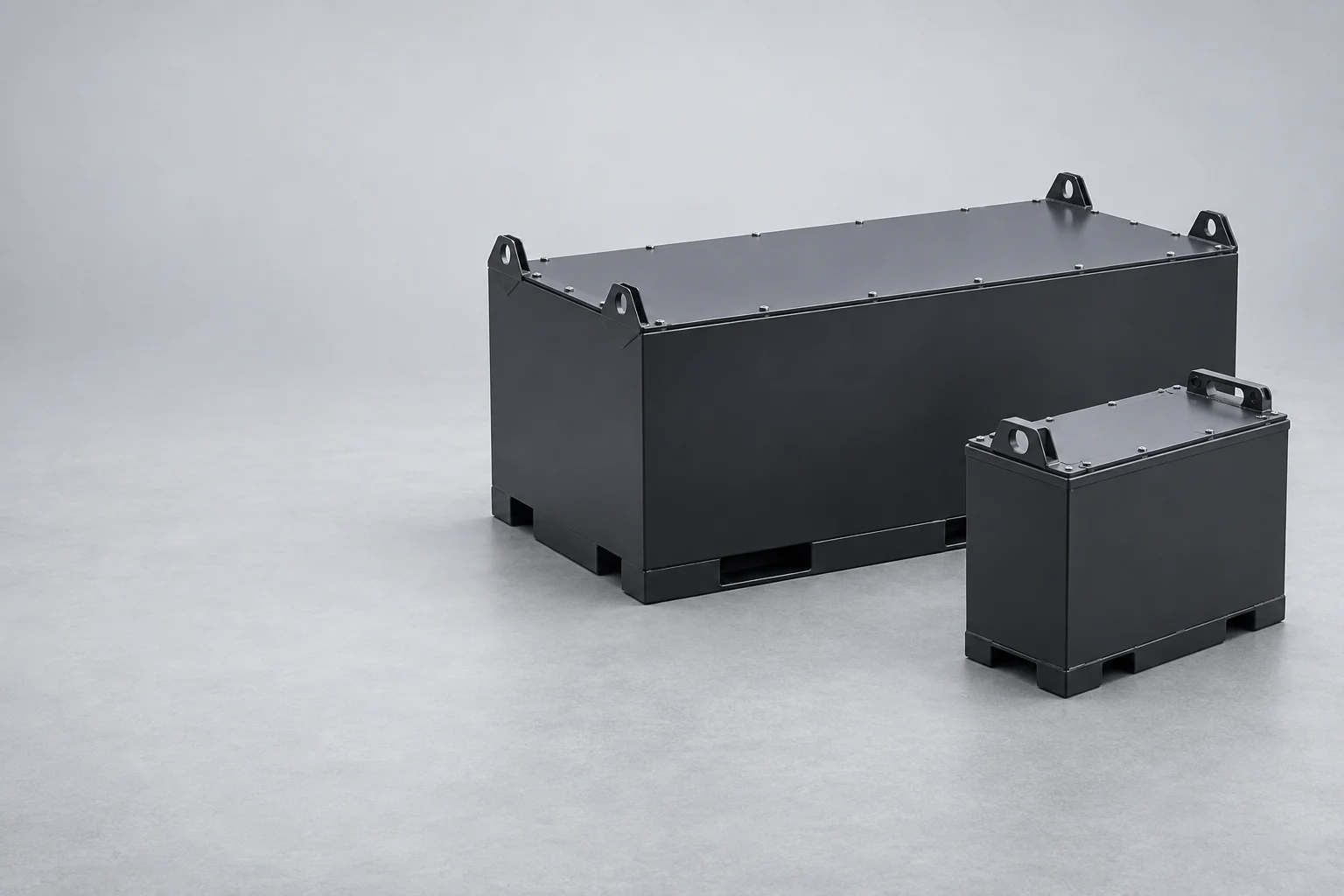
Give suppliers the same equipment identity, installed assembly and charger information, required quantity, destination and proposed scope. Request a complete response showing the offered reference, condition, included pieces, unresolved differences, delivery terms and supporting documents. Where transport or destination requirements apply, ask which item-specific documentation will accompany the proposal; do not treat a generic company certificate as proof for every pack. Keep the final decision unresolved if essential information is absent. The image illustrates battery enclosure forms only and proves no chemistry, capacity, dimensions or stock availability.
Supplier profiles for this requirement
These company routes are tied to readable manufacturer or company-controlled material reviewed on 3 October 2026. Use the stated scope to begin a shortlist. A profile does not establish current stock, certification, authorisation or a match for your truck.
The company presents industrial forklift battery applications. Use this route for a documented complete battery proposal; it does not establish a truck conversion approval or a separately stocked BMS.
For additional candidates, use the parts supplier directory. Ask each supplier to return the exact proposed item, condition, included documents, unresolved differences, quantity, destination and current delivery terms. Keep technical acceptance separate from commercial availability.
Purchasing questions
Can a nominal voltage establish battery compatibility?
No. Mechanical requirements, connection, control interfaces, charger scope and equipment documentation also matter.
Does a complete-pack supplier necessarily stock a separate BMS?
No. Ask about the exact component scope; an application page does not establish separately available subcomponents.
Can the illustration identify lithium or lead-acid chemistry?
No. It shows generic enclosure forms only. Use the actual assembly label and item documentation.
What should a battery quotation include?
An exact assembly reference, supplied scope, equipment and charger requirements, supporting documents, unresolved differences and current commercial terms.
Primary-source notes · reviewed 3 October 2026
The references below support the stated category and identification examples. Manufacturer marketing statements are not treated as independent tests. No model-specific operating values, repair procedures or performance promises are inferred for another machine.
Send the equipment identity, complete component reference, existing drawings or label photos, requested scope, quantity and destination. Mark missing information unknown and ask suppliers to answer the same written requirement.