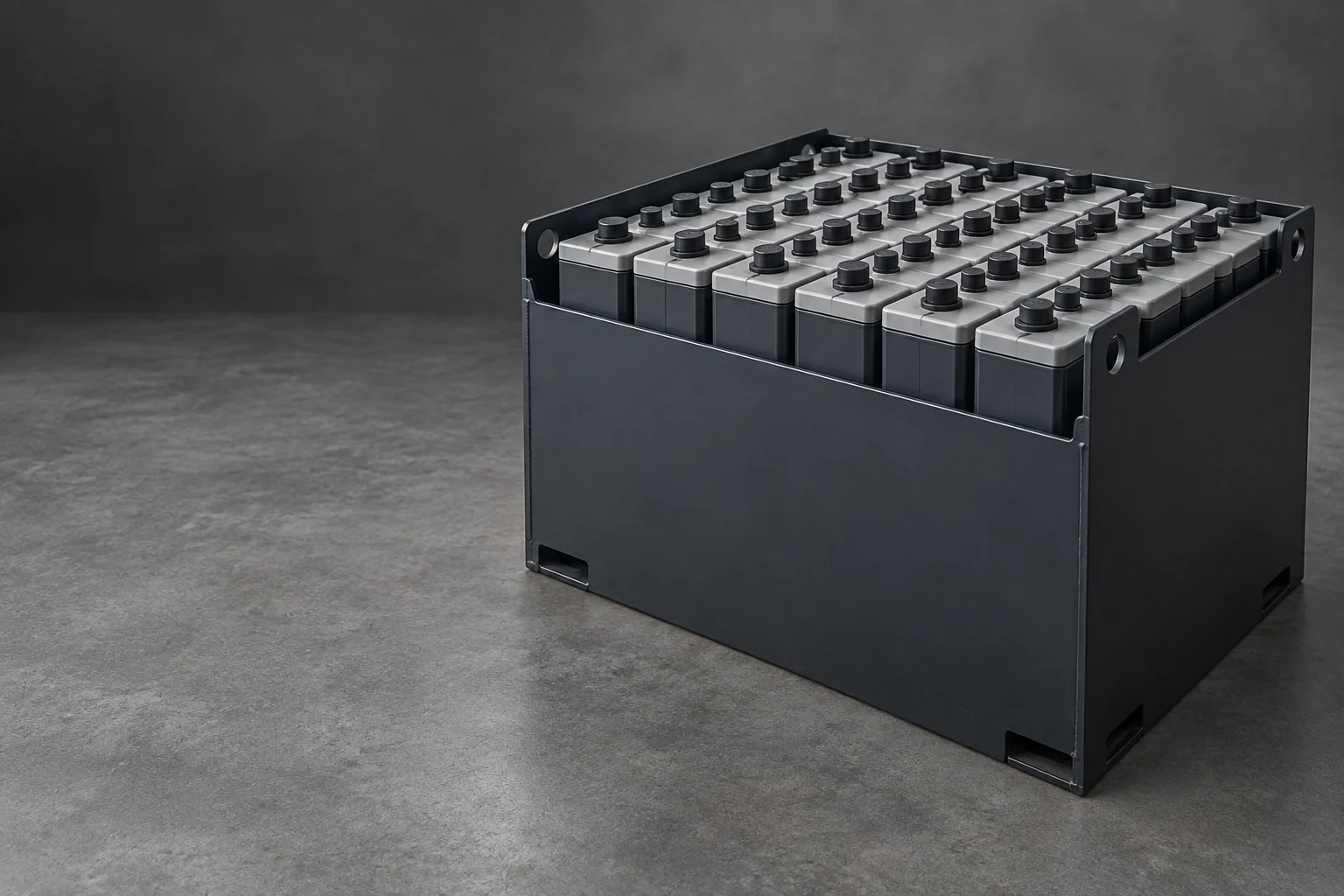
Identify the complete traction-battery assembly, its cell or assembly references, tray requirements and documented charger pairing. A starter battery, spare cell and complete forklift traction battery are different procurement scopes.
Start with the role of the requested battery. A complete forklift traction assembly, an individual cell and an engine-start battery serve different enquiry scopes. Retain the installed label and equipment documents rather than treating all lead-acid batteries as interchangeable. Ask the supplier whether it is quoting a complete tray assembly or a component. The illustration shows a generic industrial tray and cell arrangement only. It does not identify a manufacturer design, cell count, capacity or supplied product.
More guidance for this step
Build the battery identity record
Send the truck manufacturer, model, serial number and battery manufacturer or assembly reference where available. Preserve the full label, including any suffix, and the existing specification sheet. Record documented capacity information with its stated basis rather than comparing unexplained numbers. Ask for the exact proposed reference, condition and supplied scope. If an identifier is missing, mark it unknown. An approximate voltage or photograph is useful for discovery but cannot close the replacement decision or establish a cross-reference on its own.
Compare tray, weight and retention requirements
Request the assembly drawing and equipment requirements for compartment dimensions, weight and retention. These constraints should remain visible alongside the electrical information. A tray that appears to fit does not independently establish compliance with the truck’s battery-weight or retention requirement. Ask the supplier to explain differences between the existing assembly and its proposal. Do not infer dimensions from the category image or select a tray by appearance. Keep unresolved differences for competent review before a purchasing decision is treated as technically accepted.
More guidance for this step
Keep maintenance requirements document-specific
Maintenance provisions vary with the actual assembly and its manufacturer instructions. Request the applicable care documentation, included accessories and service responsibilities with the proposal. This page does not prescribe watering quantities, equalisation settings, electrolyte checks or battery-handling procedures. Neither a generic service-life estimate nor a claimed number of cycles establishes the condition or suitability of a particular assembly. For a used battery, ask for item-specific condition evidence and the basis of any stated remaining-life claim rather than accepting a category-wide promise.
Use supplier evidence within its observed scope
Berens’ company site identifies electric-forklift battery applications, a forklift matching category and traction lead-acid material. Those source bodies support a bounded enquiry route. They do not substantiate approved fit for your truck or current stock for a requested reference. Ask the company to identify the legal entity making the offer and the actual manufacturer and assembly it proposes. Request its supporting drawing, battery documents, condition, quantity and delivery terms. Brand references on a website are not treated here as proof of current authorisation.
More guidance for this step
Compare the complete offer, including charging scope
Provide the existing charger identity and documented battery configuration to every shortlisted company. Ask which charger pairing the offer assumes and whether accessories, connection pieces or other assembly elements are included. If both battery and charger are changing, keep them together in the energy-system enquiry. Separate technical acceptance from price, destination and lead time. Record outstanding questions and exclusions. A written quotation without the required identification and supporting documents is still an incomplete proposal, even if the commercial terms appear attractive.
Supplier profiles for this requirement
These company routes are tied to readable manufacturer or company-controlled material reviewed on 3 October 2026. Use the stated scope to begin a shortlist. A profile does not establish current stock, certification, authorisation or a match for your truck.
The company website presents electric-forklift battery applications, traction lead-acid material, and a charger/accessory category. Use this as a documented enquiry route; the site does not establish your assembly match, current stock or brand authorisation.
For additional candidates, use the parts supplier directory. Ask each supplier to return the exact proposed item, condition, included documents, unresolved differences, quantity, destination and current delivery terms. Keep technical acceptance separate from commercial availability.
Purchasing questions
Is a starter battery a forklift traction replacement?
Do not assume so. Identify the actual equipment function and complete assembly requirement before comparing offers.
Is matching voltage and capacity enough?
No. Retain the tray, weight, retention, connection and documented charger requirements as well.
Does a general cycle-life claim prove battery condition?
No. Ask for evidence specific to the proposed assembly and its stated condition; category averages do not establish remaining life.
Can I request an individual cell here?
State that narrower scope explicitly, retain the assembly and cell identity, and request application-specific documents. A cell enquiry is not a complete-battery approval.
Primary-source notes · reviewed 3 October 2026
The references below support the stated category and identification examples. Manufacturer marketing statements are not treated as independent tests. No model-specific operating values, repair procedures or performance promises are inferred for another machine.
Berens forklift and traction lead-acid application material; no stock or fit inference: http://www.ccsopower.com/
Prepare a parts matching request
Send the equipment identity, complete component reference, existing drawings or label photos, requested scope, quantity and destination. Mark missing information unknown and ask suppliers to answer the same written requirement.