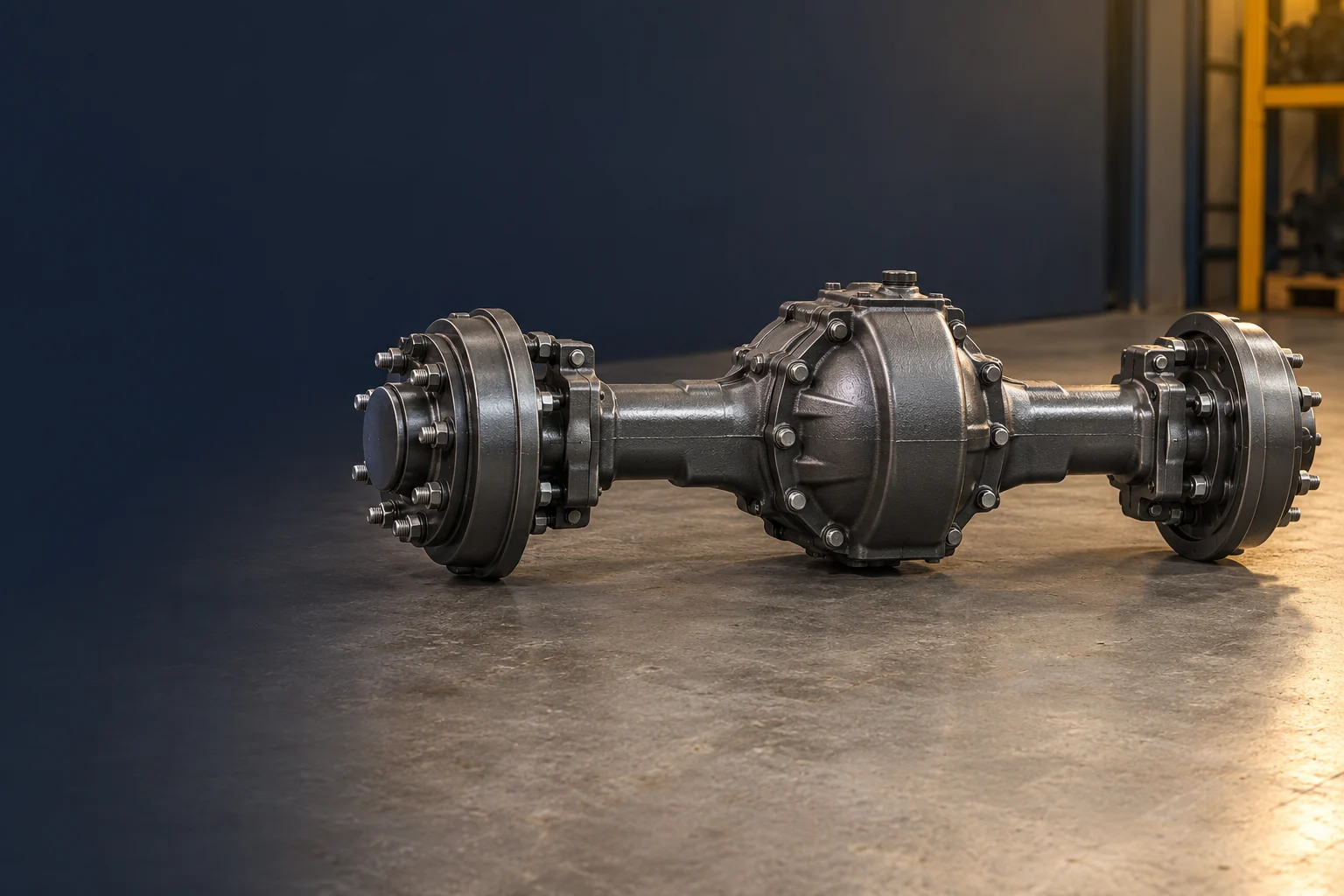
A forklift drive axle or gearbox enquiry needs the complete assembly reference, truck identity and documented interface configuration. Separate a complete axle, reduction unit, gear set and service component. Axle appearance, truck capacity or an unexplained noise cannot establish the correct replacement.
Find the assembly identity before a component number
Record the truck make, model, serial identity and relevant configuration, then retain every readable axle or gearbox identification mark. Ask whether the number identifies the full assembly, a casting, a gear, a bearing or a drawing item. Keep photographs associated with their location on the machine. A capacity class or similar housing is an initial clue, not a compatibility decision. Request the supplier catalogue or drawing that connects the proposed reference with the existing assembly, including revision and serial boundaries.
More guidance for this step
A manufacturer catalogue illustrates the boundary
Anqing Heli Axle lists distinct drive-axle and drive-unit references, including T1HC1-00001A and AQ-Q03G2-10000, on its manufacturer-controlled drive-axle index. These are examples of separate catalogue entries, not cross-references to your truck. Preserve complete suffixes and the stated application in an enquiry. The catalogue supports the company route below, but it does not establish that every assembly, gear or service component can be supplied individually, that stock is present, or that the listed design fits a different vehicle.
Define the complete assembly and its exclusions
Ask the supplier to list the proposed housing, reduction and differential scope, hubs, shafts, brake equipment, seals and accessories as applicable to the identified assembly. For an integrated electric unit, resolve motor and feedback inclusion separately. For a bare housing or gear-set proposal, state which existing components would remain and who must approve that combination. A photograph of a complete axle does not define a kit. Use a drawing and itemised scope so a lower price is not mistaken for an equivalent assembly.
More guidance for this step
Retain ratio, mounting and wheel interface evidence
Request the documented reduction ratio, assembly orientation, mounting features, wheel or hub interface and connections to the upstream drive. Ask which drawing and revision establish those details. Capacity descriptions cannot replace interface information, and an external width does not establish every internal relationship. Where the design includes brakes or electrical interfaces, request those documents too. Do not choose lubricants, adjustment values or tightening settings from a generic product page; those are controlled by the applicable machine and assembly documentation.
A gear or bearing request is a different purchase
For subcomponents, retain the assembly reference plus the drawing item number and the exact service part reference. Ask whether a proposal is one gear, a documented paired set, a bearing, a seal or a broader repair kit. Have the supplier identify included quantities and the evidence supporting each substitution. A bearing number alone may leave installation and assembly requirements unresolved. Treat alternative manufacturers, used components and refurbished units as separate proposals with their own condition, traceability and acceptance documents rather than assumed equivalents.
More guidance for this step
Keep noise reports separate from replacement selection
A noise, vibration or travel complaint describes an observation, not a confirmed worn gear or bearing. Preserve operating circumstances and existing inspection findings for the responsible technician. This purchasing guide does not recommend an oil change as a universal cure or provide axle disassembly, backlash adjustment or lifting procedures. Request a technically identified replacement scope after the applicable inspection. Retain unresolved questions in the enquiry so the supplier is not asked to infer an entire diagnosis from a sound description or a broad truck model.
Supplier profiles for this requirement
These company routes are tied to readable manufacturer or company-controlled material reviewed on 3 October 2026. Use the stated scope to begin a shortlist. A profile does not establish current stock, certification, authorisation or a match for your truck.
The manufacturer-controlled drive-axle catalogue lists distinct axle and drive-unit references. Use this route for assembly identification and a current proposal; catalogue presence does not establish stock or suitability for another truck.
For additional candidates, use the parts supplier directory. Ask each supplier to return the exact proposed item, condition, included documents, unresolved differences, quantity, destination and current delivery terms. Keep technical acceptance separate from commercial availability.
Purchasing questions
Is the truck capacity enough to select an axle?
No. Obtain the full axle reference, machine configuration, interface drawings and supplier matching basis. Similar capacity classes can contain different assemblies.
Does an axle catalogue include every service part?
No. Ask which complete assemblies or individual components are actually proposed and require an itemised current scope.
Can a gear set be ordered by housing appearance?
Appearance is insufficient. Retain assembly identity, drawing item numbers and the evidence for a proposed gear or matched set.
Does the profile guarantee HELI original parts?
No. The manufacturer-controlled source supports an identification route. The actual legal supplier, item identity, origin and availability must be confirmed in the offer.
Primary-source notes · reviewed 3 October 2026
The references below support the stated category and identification examples. Manufacturer marketing statements are not treated as independent tests. No model-specific operating values, repair procedures or performance promises are inferred for another machine.
Manufacturer-controlled drive-axle index and separate named assembly references: https://www.helichina.com/aqcq/cpzx/qdq/
Prepare a parts matching request
Send the equipment identity, complete component reference, existing drawings or label photos, requested scope, quantity and destination. Mark missing information unknown and ask suppliers to answer the same written requirement.