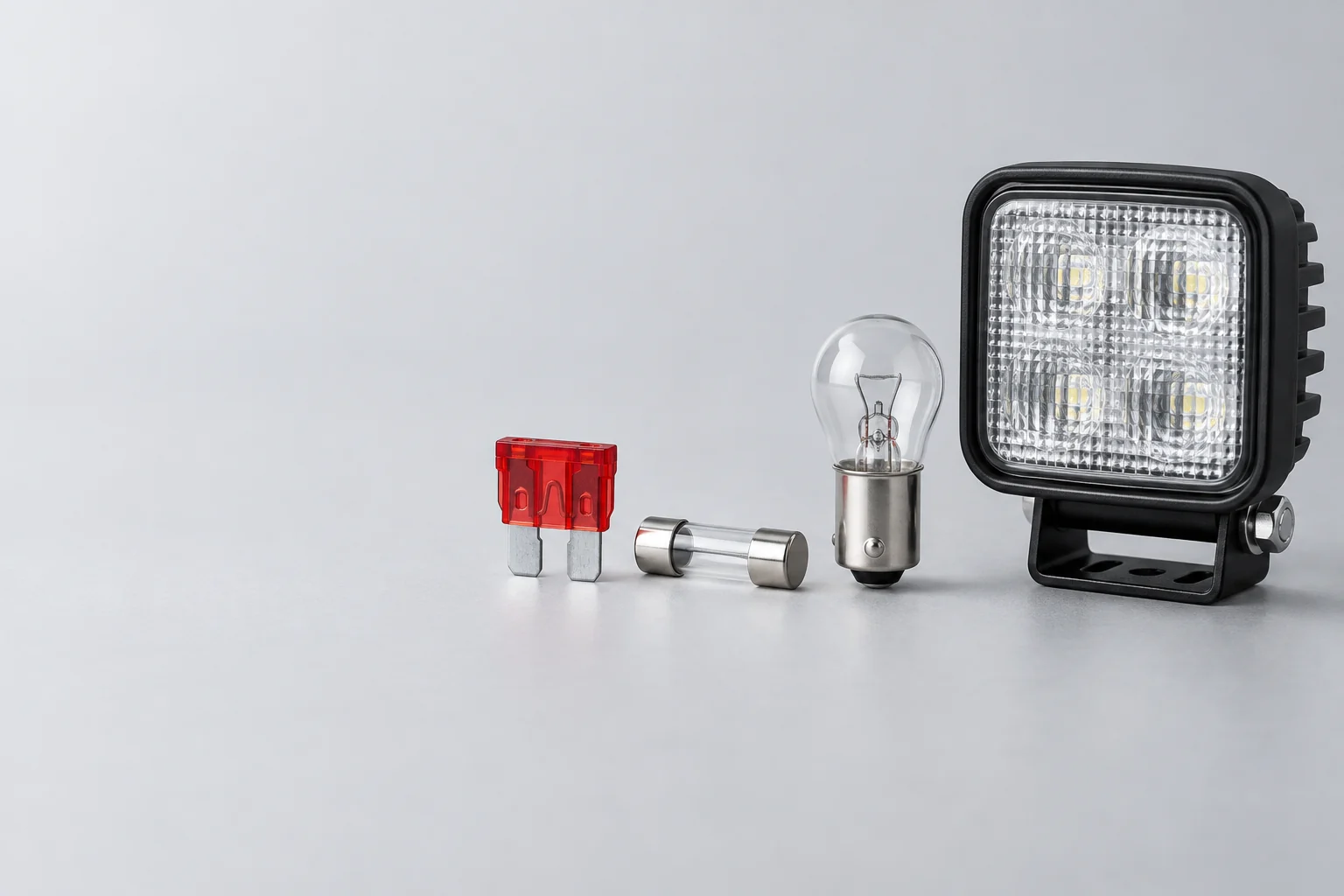
Separate circuit-protection parts from bulbs, sockets and complete work lights. Match the documented reference and application; visual similarity or an approximate voltage description is insufficient for replacement selection.
A fuse protects a specified circuit; a bulb is a light source; a socket is a connection and retention component; a work lamp may be a complete assembly. Identify which of these is needed before asking for prices. Describe the truck and installed reference, and distinguish an auxiliary accessory from a battery or traction-system part. A category grouping helps discovery but does not create a shared fit rule. Ask whether the proposal replaces a complete assembly or only one of its components.
More guidance for this step
Specify protection from equipment documents
For a fuse enquiry, retain the exact installed reference and the protection requirement stated in the relevant equipment documents. Ask for the proposed item’s documented ratings, characteristic, dimensions and applicable circuit context. Do not choose a higher-rated fuse to address repeated operation, or assume that a physically similar accessory fuse is appropriate for a traction circuit. This page provides no diagnostic or live electrical procedure. An unresolved circuit condition should remain a separate technical issue rather than being treated as a purchasing shortcut.
Compare the complete lighting interface
Record the light or bulb reference, documented supply, base or connector, mounting and available clearance. For a complete lamp, request a drawing and information about the included connection or mounting pieces. Similar appearance does not establish the same light distribution, environmental suitability or equipment application. Avoid describing all forklift accessories as operating across one generic voltage range. Keep any claimed protection or performance property tied to the supplier document for the actual proposed item, rather than to a category illustration or product-family name.
More guidance for this step
Preserve the socket and assembly distinction
A bulb-socket catalogue entry does not establish that the socket fits the installed lamp housing or includes a bulb. Likewise, a lamp listing may not include the bracket or harness shown elsewhere. Ask suppliers to identify each included component and any retained original piece. Provide accessible markings and existing drawings where available, without dismantling equipment to obtain them. If a description is incomplete, ask for clarification before combining it with another listing. Separate scope reduces quotations that appear comparable but supply different assemblies.
Use the catalogue route conservatively
Autopax’s company-controlled site presents fuse, work-lamp and bulb-socket categories. These readable category pages support an auxiliary electrical sourcing enquiry. They do not independently establish current stock, original manufacturer status or the suitability of a fuse for a high-current battery circuit. Ask the company to identify its exact proposed reference and provide the applicable documentation. Record the condition, manufacturer identification, quantity and destination. A catalogue category is a starting point for comparison, not a finished technical approval or guaranteed commercial offer.
More guidance for this step
Keep the purchasing decision auditable
Build a record containing the equipment identity, installed item, required scope, supplier response and unresolved differences. Compare pricing only after the proposed assemblies and documentation are clear. Ask for current delivery terms, packaging and any claimed conformity evidence specific to the item; do not infer those properties from the company profile. The illustration separates common component forms for orientation. It is not a wiring diagram, rating label or actual stock photograph. Installation and circuit-condition questions belong with equipment-specific technical documentation and qualified review.
Supplier profiles for this requirement
These company routes are tied to readable manufacturer or company-controlled material reviewed on 3 October 2026. Use the stated scope to begin a shortlist. A profile does not establish current stock, certification, authorisation or a match for your truck.
Company-controlled categories cover fuses, work lamps and bulb sockets. This is an auxiliary electrical sourcing route, not evidence that a listed fuse suits a traction battery circuit.
For additional candidates, use the parts supplier directory. Ask each supplier to return the exact proposed item, condition, included documents, unresolved differences, quantity, destination and current delivery terms. Keep technical acceptance separate from commercial availability.
Separate fuse protection, sockets and complete lamps
Autopax has distinct category bodies for fuses, bulb sockets and work lamps. Its fuse directory shows blade, flat and bolt-on formats; the socket directory separates several bases. These headings help identify the component family, but shape alone does not establish the protective function or a replacement match. Include the installed complete reference and holder or socket identity; for a complete lamp, itemise mounting and electrical documents separately. The reviewed /product/8/48 page is the bulb-socket catalogue, not a switch category. Ask for the offered item’s own documentation rather than extending catalogue labels to the entire family.
Original company-controlled bodies reviewed on 4 October 2026. Inclusion confirms a research route; it does not confirm inventory, authorization or fitment.
A work-lamp enquiry route with a narrower supply scope
Ningbo NOVA lists work lamps within its vehicle-lighting sourcing activity. Use this profile for an identified complete work-lamp enquiry. It is not evidence of fuse, socket or replaceable-bulb coverage. Ask for the exact lamp reference, producer, mounting drawing and current electrical documents. A general lighting category does not confirm that NOVA manufactures the proposed item or that a lamp matches the truck.
Company-controlled bodies reviewed on 4 October 2026. Supplier discovery, item origin, current supply and truck-specific acceptance remain separate decisions.
No. The documented protection requirement and item specification must also match the equipment application.
Does this page cover a traction battery fuse?
It identifies that as a separate system-specific requirement. An accessory catalogue category does not establish traction-circuit suitability.
Does a work lamp include its bracket and harness?
Confirm the written assembly scope; do not infer included pieces from another photograph or listing.
Is a bulb socket the same as a complete light?
No. Specify the socket, bulb or complete lamp separately and request the appropriate interface documentation.
Primary-source notes · reviewed 3 October 2026
The references below support the stated category and identification examples. Manufacturer marketing statements are not treated as independent tests. No model-specific operating values, repair procedures or performance promises are inferred for another machine.
Send the equipment identity, complete component reference, existing drawings or label photos, requested scope, quantity and destination. Mark missing information unknown and ask suppliers to answer the same written requirement.