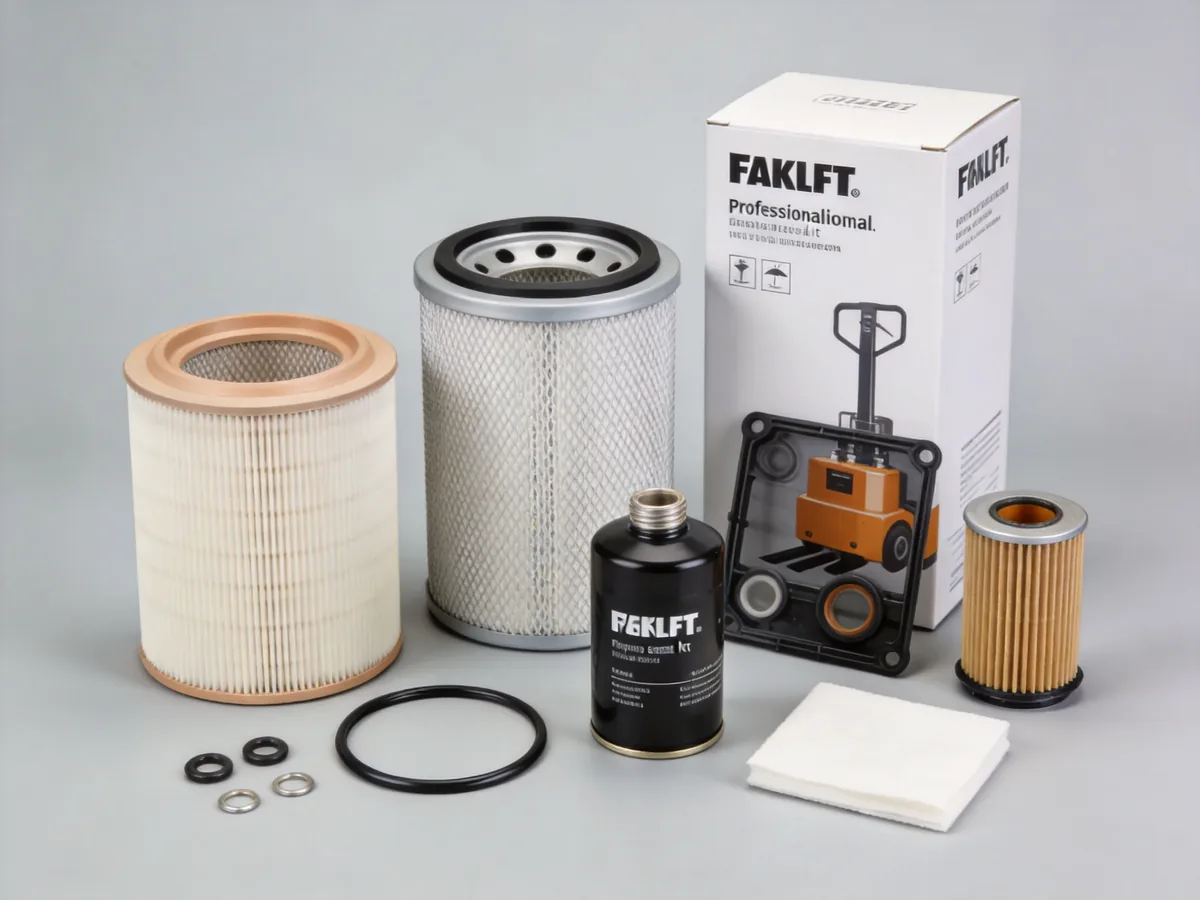
Build maintenance orders from the fleet’s actual equipment records and service requirements. Filter, kit, fuse and wear-part labels describe purchasing categories; they do not establish a common service interval or prove that a visually similar item is suitable.
Give each truck a record containing manufacturer, full model, serial number, configured mast and power source. Attach the applicable service-document reference and the part numbers used for documented service work. Toyota’s plate guide explains why model and serial information matters when matching parts. Keep similar models as separate equipment records until the relevant catalogue establishes a common component. This avoids copying a maintenance basket from one truck to another because the brand looks familiar.
Specify the filter rather than its appearance
A filter order should retain the complete existing reference and the housing or circuit application. Record an existing documented cross-reference as a lead and ask the supplier for the current catalogue basis of the proposed replacement. Similar thread, shape or colour cannot answer the application question. Keep filter elements, housings and any additional service parts as separate lines. This page does not prescribe a filtration rating, fluid or maintenance interval for every forklift; those belong to the equipment-specific requirement.
More guidance for this step
Check what a repair kit actually contains
A kit can contain a subset of the parts associated with an assembly. Ask for a contents list, the parent assembly reference and any version or serial restriction. Zhaohui’s company website lists repair kits alongside brake product categories; Decha’s catalogue shows a diagnostic gear-ring repair-kit reference. These are scoped examples of kit enquiries, not a promise that either company supplies every seal, filter or electrical consumable. Distinguish the required kit from a complete replacement assembly.
Plan quantity from the service record
Use the established service schedule, fleet population, actual usage record and current purchasing need to define quantity. Separate an immediately required replacement from a planned service order and from reserve stock. This page makes no claim that a specific group of items has the highest repurchase rate or that stocking it guarantees less downtime. Ask for the supplier’s available quantities, order basis and current delivery estimate rather than converting a category list into a stocking rule.
Make repeat orders traceable
Store the equipment and component identity, the accepted supplier reference, condition and included items with each order. If a supplier proposes a superseded number or a substitute, request the supporting catalogue record and document the difference before accepting it. Keep the previous order as a record, not permanent compatibility proof. Maintenance records and supplier catalogue data can change. A later repeat enquiry should still identify the intended truck and the component version so substitutions remain visible.
Supplier profiles for this requirement
These company routes are tied to readable manufacturer or company-controlled material reviewed on 2 October 2026. Use the stated scope to begin a shortlist. A profile does not establish current stock, certification, authorisation or a match for your truck.
The manufacturer website lists forklift brake shoes, brake assemblies, parking-brake handles and repair kits. These are discovery categories; ask for the exact assembly, contents and drawing applicable to your equipment.
The current aftermarket catalogue includes a Jungheinrich steering-sensor reference and a diagnostic gear-ring repair-kit reference. Keep the specific reference and truck serial identity together when requesting a proposal; no listing establishes stock or universal compatibility.
For additional candidates, use the parts supplier directory. Ask each supplier to return the exact proposed item, condition, included documents, unresolved differences, quantity, destination and current delivery terms. Keep technical acceptance separate from commercial availability.
Use an engine or component-specific supplier route
Separate the truck identity, engine identity and installed component reference before making a request. Manufacturer after-sales channels and radiator specialists answer different procurement questions.
Hengchen Power — Forklift radiators and cooling-component enquiries.
The Yuchai profile is an engine-identity and after-sales route; it does not confirm this individual service item is available. Hengchen is a radiator route, not a pump or filter supplier.
Official website scopes reviewed on 4 October 2026. Current inventory, authorization, genuine origin and matching remain to be documented in a supplier offer.
Is there one service-parts list for all forklifts?
No. Build the list from the truck configuration, applicable service documentation and identified component references.
Can a filter be matched by its appearance?
Appearance can narrow discovery but does not establish the circuit application or specification. Ask for a traceable current catalogue match.
What should I ask about a repair kit?
Request the parent assembly, kit reference, version restrictions and complete contents list. A kit title does not prove that every needed component is included.
Does this page set service intervals?
No. Follow the equipment-specific service requirement. This category helps organise the purchasing information without prescribing inspection or repair work.
Primary-source notes · reviewed 2 October 2026
The references below support the stated category and identification examples. Manufacturer marketing statements are not treated as independent tests. No model-specific operating values, repair procedures or performance promises are inferred for another machine.
Equipment identity for parts communication: https://www.toyotaforklift.com/resource-library/blog/toyota-products/what-is-a-forklift-data-plate-and-how-do-i-read-it
Specific repair-kit catalogue example: https://www.dechaparts.com/
Prepare a parts matching request
Send the equipment identity, complete component reference, existing drawings or label photos, requested scope, quantity and destination. Mark missing information unknown and ask suppliers to answer the same written requirement.