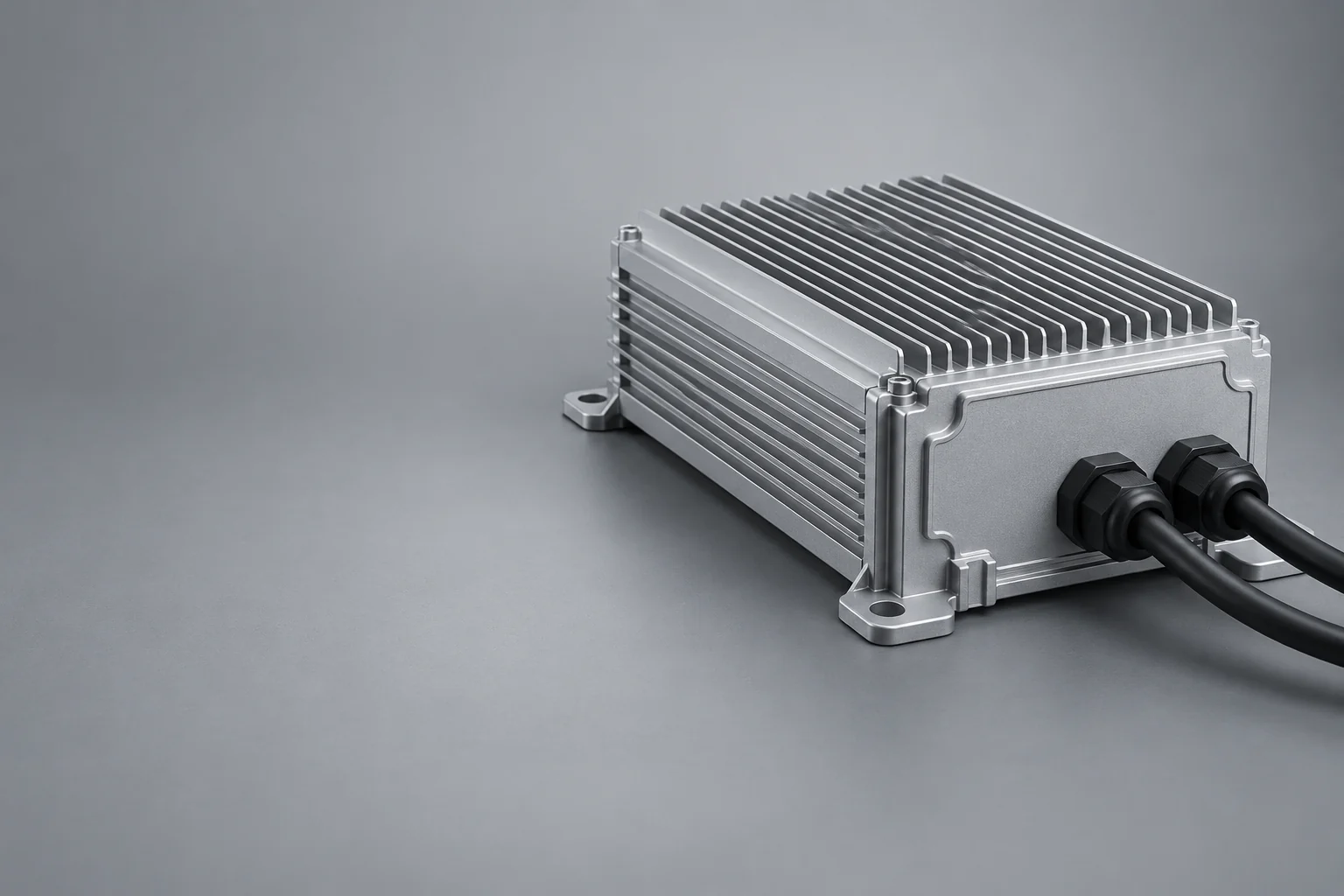
An onboard charger is part of an installed vehicle charging arrangement. Identify its exact reference, battery pairing, mounting and documented supply requirements; being onboard does not mean it can use any outlet or replace any external charger.
Retain the truck manufacturer, model, serial number and existing onboard charger reference. State whether the enquiry concerns a complete charging module, a service component or a proposed change of charging arrangement. Ask which cables, brackets, interfaces and documents are included. A compact finned enclosure is not enough to identify a charger or prove its application. Use accessible labels and existing records; this page does not require opening equipment or making electrical measurements to prepare an enquiry.
More guidance for this step
Keep onboard mounting distinct from charging compatibility
The mechanical installation and the battery pairing are separate questions. Request the proposed module drawing, mounting requirements, clearance and environmental documentation, together with the exact battery configuration it is intended to serve. A module that fits the available space is not automatically a compatible charger. Conversely, a documented battery profile does not establish that the module fits the truck’s installation. Keep each unresolved difference visible and ask who will assess the proposed arrangement against the relevant equipment documents.
Request the actual profile and interface documents
Delta-Q’s IC Series material distinguishes model configurations, supported charging algorithms and communication options. Its material-handling discussion includes onboard charging, illustrating why the configuration matters. This is a named-family example, not approval of an IC charger for an arbitrary forklift or battery. Request the exact reference and applicable documents if it appears in a proposal. Do not transfer catalogue features to another unit, or assume that the same communication connector implies compatible messages, programming or equipment integration.
More guidance for this step
Retain the documented supply and site requirements
Being installed on a truck does not establish that a charger can operate from any standard outlet. Preserve the existing input label and site documents, and request the requirements for the proposed unit and location. Mark unknown information for qualified review. Describe the operating pattern and charging windows without assuming that onboard means lower power, slower charging or unrestricted opportunity charging. This guide gives no outlet approval, wiring scheme, plug conversion or charging settings; installation decisions follow the equipment-specific documentation and competent assessment.
Use the company route as an identification enquiry
Ningtai’s site describes portable and vehicle charging products and forklift applications. This supports an enquiry route for identifying a proposed installed charging solution, not a confirmed replacement for your onboard module. Ask the company to return its exact offered reference, intended scope, drawing and battery-interface documents. Clarify whether it is proposing a supported service replacement or a new integration. Keep the manufacturer, legal quoting entity, condition, quantity and destination in the response. Stock and installation approval remain unconfirmed.
More guidance for this step
Compare the whole installed proposal
Ask each candidate to identify retained original components, added equipment, supporting documents and responsibilities. Keep battery and truck acceptance alongside the mounting and supply requirements rather than comparing only the module price. Ask for a written list of exclusions and unresolved differences before commercial selection. The illustration shows generic enclosed power-electronics form, not a supplied onboard model, wiring layout or environmental rating. An incomplete technical response should remain open even where the requested module size and delivery timing appear to match.
Supplier profiles for this requirement
These company routes are tied to readable manufacturer or company-controlled material reviewed on 3 October 2026. Use the stated scope to begin a shortlist. A profile does not establish current stock, certification, authorisation or a match for your truck.
Company-controlled material describes intelligent chargers and portable or vehicle charging applications, including forklifts. This is a charger-identification enquiry route: the exact high-frequency or onboard configuration, stock and equipment compatibility remain unconfirmed.
For additional candidates, use the parts supplier directory. Ask each supplier to return the exact proposed item, condition, included documents, unresolved differences, quantity, destination and current delivery terms. Keep technical acceptance separate from commercial availability.
Purchasing questions
Can an onboard charger use any outlet?
No such assumption is justified. Retain its input label and applicable site documents for qualified review.
Is onboard always slower than an external charger?
Do not generalise from mounting location. Compare the documented unit, battery configuration and operating conditions.
Does the module housing establish fit?
No. Mounting, battery pairing, supply and control interfaces all require application-specific documentation.
Does a vehicle-charger catalogue prove an installed spare?
No. Request the exact proposed reference and clarify supported replacement versus new integration scope.
Primary-source notes · reviewed 3 October 2026
The references below support the stated category and identification examples. Manufacturer marketing statements are not treated as independent tests. No model-specific operating values, repair procedures or performance promises are inferred for another machine.
Delta-Q IC Series configuration and material-handling integration examples: https://delta-q.com/our-products/ic-series/
Ningtai vehicle charging and forklift application material: https://ntbms.cn/
Prepare a parts matching request
Send the equipment identity, complete component reference, existing drawings or label photos, requested scope, quantity and destination. Mark missing information unknown and ask suppliers to answer the same written requirement.