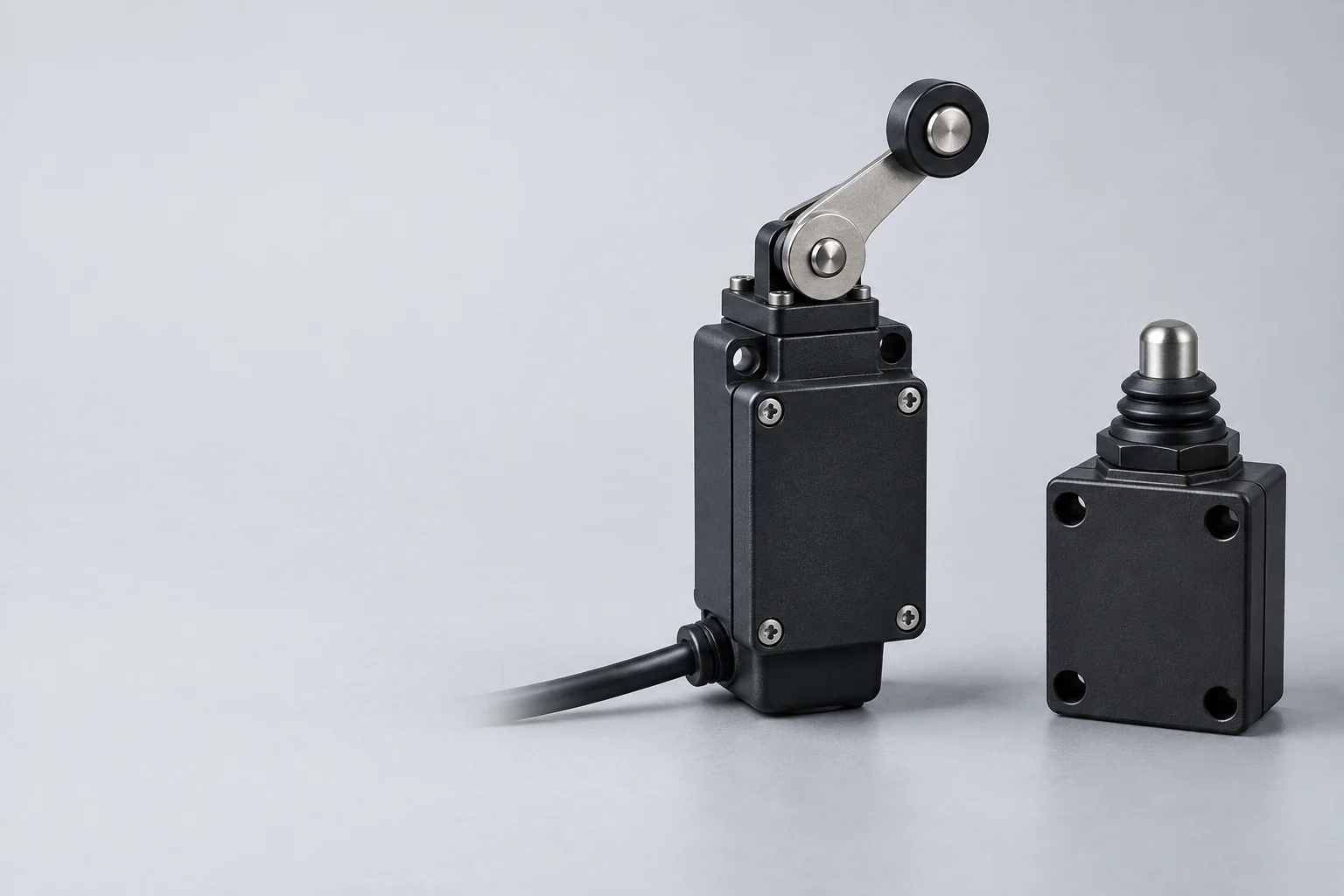
Identify a forklift limit switch or interlock by its complete reference, actuator, contact arrangement, mounting and documented machine function. A general microswitch is not automatically a suitable safety replacement. Component specifications alone do not validate the truck’s complete safety function.
Record the installed switch reference and the function assigned to it in the truck documentation. A switch described as a limit, seat, brake or safety switch may belong to a different assembly or circuit. Keep the truck model, serial number and parent assembly reference with the enquiry. Do not select a replacement from the symptom or catalogue category alone. This page supports identification and procurement; it does not establish a fault diagnosis or permission to operate a machine.
More guidance for this step
Specify the actuator and mechanical scope
Request the exact actuator form, mounting drawing and supplied assembly scope. Roller levers, plungers and other mechanical arrangements can look similar while presenting different requirements. Distinguish a bare switch from an assembly with bracket, lever, harness or enclosure. Ask which accessories are included and which existing parts the proposal expects to retain. Do not treat an illustration as dimensional evidence. Retain an identifiable drawing for the offered reference and mark absent information unknown.
Retain the complete contact configuration
OMRON’s D4N family includes different contact forms and connector options. That manufacturer example explains why the complete ordering code matters; it does not demonstrate a forklift application. Ask for the proposed switch datasheet and the truck-specific basis for its selection. Terminal count or connector appearance is insufficient to identify the intended contact arrangement. Do not transfer ratings from another variant or infer direct-opening characteristics from a generic limit-switch description.
More guidance for this step
Separate a component from a safety function
A supplier listing, component certification or manufacturer safety-category name does not validate an assembled truck function. Ask the responsible technical reviewer to resolve the component’s documented role, required characteristics and application evidence. Preserve that review as a separate requirement from price and delivery. This guide does not describe bypassing an interlock, changing its logic, adjusting actuation or testing a live machine. A commercial quotation cannot substitute for technical acceptance of a safety-related application.
Use catalogue routes within their scope
Decha’s company catalogue lists microswitch and proximity-switch references associated with Linde and Jungheinrich. These provide useful identification enquiry routes, but a listed microswitch is not proof of an approved interlock replacement. Keep the full reference and assembly context in the request. Ask the supplier to distinguish a mechanical switch from a sensing device and explain any proposed substitute using documents. Original-part status, certification, serial-range fit and current availability remain separate questions.
More guidance for this step
Prepare a comparable written offer
Require the complete code, condition, actuator, contact documentation, mounting scope, included accessories, application basis, warranty and current delivery terms. Track every unresolved difference so the reviewer can see it. Retain seat-related symptom information as context only; a no-travel symptom does not determine the correct part. A useful shortlist compares the same documented requirement across suppliers. Reject undocumented equivalence claims rather than silently treating a cheaper general-purpose switch as the required assembly.
Supplier profiles for this requirement
These company routes are tied to readable manufacturer or company-controlled material reviewed on 3 October 2026. Use the stated scope to begin a shortlist. A profile does not establish current stock, certification, authorisation or a match for your truck.
Its switch catalogue includes a Linde-referenced 0039733016 microswitch sensor and a Jungheinrich-referenced 50425711 proximity switch. Use the profile for reference identification enquiries. These listings do not demonstrate a validated safety function or approval for your serial range.
For additional candidates, use the parts supplier directory. Ask each supplier to return the exact proposed item, condition, included documents, unresolved differences, quantity, destination and current delivery terms. Keep technical acceptance separate from commercial availability.
Keep the seat-presence route narrowly scoped
KL Seating publishes a separate micro-switch category with occupancy-detection and operator-presence seat entries. Use this route only for the identified seating-related component. The observed catalogue does not establish a supply route for a mast limit switch, general interlock, emergency-stop device or a complete safety system. Ask for the full component reference and equipment-specific interface documents; no bypass, adjustment or safety validation follows from directory inclusion.
Do not assume equivalence. Resolve the full component and machine-function requirements with application-specific evidence.
Does a safety label validate the whole forklift function?
No. Component characteristics and machine-level technical acceptance are separate requirements.
Are terminal counts sufficient for matching?
No. Request the exact ordering code, contact documentation, actuator and mounting information.
What belongs in the enquiry?
Truck and assembly identity, complete reference, actuator, contact and mounting documents, included scope and unresolved application differences.
Primary-source notes · reviewed 3 October 2026
The references below support the stated category and identification examples. Manufacturer marketing statements are not treated as independent tests. No model-specific operating values, repair procedures or performance promises are inferred for another machine.
Manufacturer example of contact forms and connector variants, not truck fit: https://www.ia.omron.com/products/family/1497/
Company-controlled microswitch and proximity-switch reference leads: https://www.dechaparts.com/?s=switch&post_type=product
Prepare a parts matching request
Send the equipment identity, complete component reference, existing drawings or label photos, requested scope, quantity and destination. Mark missing information unknown and ask suppliers to answer the same written requirement.